
THE ANCIENT ENGINE: NASA Just Dated 3I/ATLAS to Before the Sun Existed
Two teams. Two continents. Two instruments. Same answer. The chemistry transformed at perihelion. Then Harvard ran the mass budget: the universe doesn't have enough material to create this thing.

DATE: MARCH 12, 2026
SUBJECT: COMBINED FORENSIC ANALYSIS OF ARXIV:2603.06911 (CORDINER ET AL.) | ARXIV:2603.07187 (OPITOM ET AL.) | ARXIV:2603.07718 (ZHAO ET AL.) | LOEB 2026
CROSS-REF: [THE IGNITION SEQUENCE] | [THE GHOST COMA] | [THE WIDE ANGLE] | [THE CURATED ORBIT] | [THE HEARTBEAT] | [THE SURGE] | [THE SENTINEL DOSSIER] | [THE DECEMBER INTERSECTION] | [THE SPHEREx INTERCEPT] | [DOSSIER 001]
CLEARANCE: PUBLIC
DATA CONFIDENCE: VERIFIED (JWST NIRSpec, VLT/UVES, Beijing 2.16m, Lijiang 2.4m, Hubble photometry) + HYPOTHESIS (Sentinel cross-reference analysis, mass budget calculation)
FOUR PAPERS. FOUR NIGHTS BEFORE JUPITER.
On March 16th, 3I/ATLAS crosses into Jupiter’s Hill Sphere.
Since December, we have catalogued fifty-three plus anomalies across twenty-seven plus briefings.
We have documented what this thing does. How it moves. What it produces. How the institutions react when you ask questions about it.
One question nobody could answer: how old is this thing?
Four papers dropped this week. Now we know.
PART ONE: THE AGE
THE EXPIRATION DATE
Every carton of milk has a date on it. You didn’t put it there. The dairy did. It tells you when and where that milk was packaged.
Water works the same way, except the expiration date is atomic.
Regular hydrogen has one proton. Deuterium, the heavier version, has a proton and a neutron. When water freezes in deep space, the ratio between these two gets locked in by the temperature and environment where the ice formed. Warmer environment, lower ratio. Colder, more shielded environment, higher ratio. Once the ice is set, that number does not change. Not in a million years. Not in ten billion. It is a timestamp baked into the molecule itself.
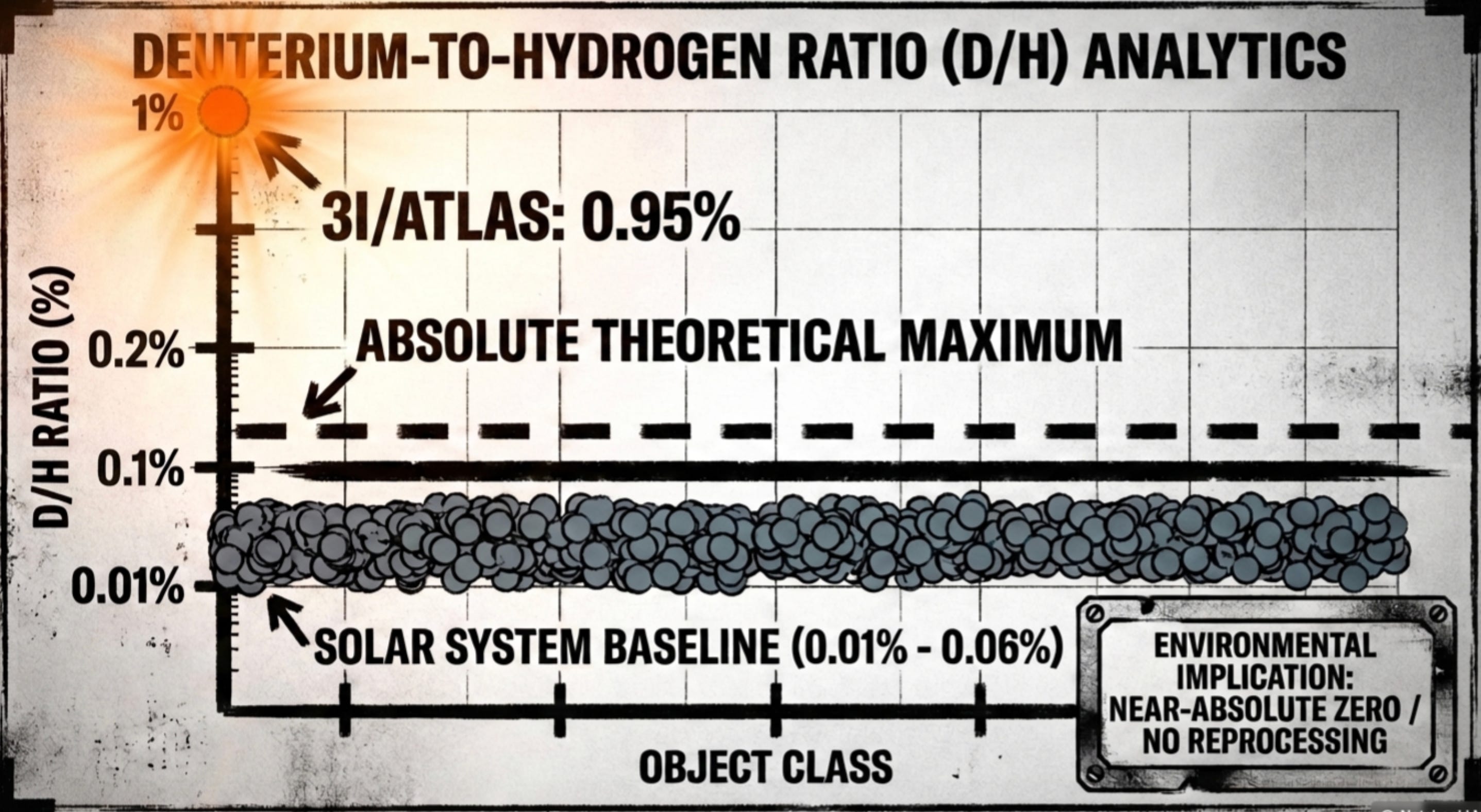
Every comet we have ever measured in our solar system carries a D/H ratio between 0.01 and 0.06 percent. Earth’s oceans sit at 0.015 percent. The most extreme outlier in our entire neighborhood tops out around 0.06 percent. That is the range. That is the shelf.
NASA’S JWST just read the expiration date on 3I.
THE NUMBER
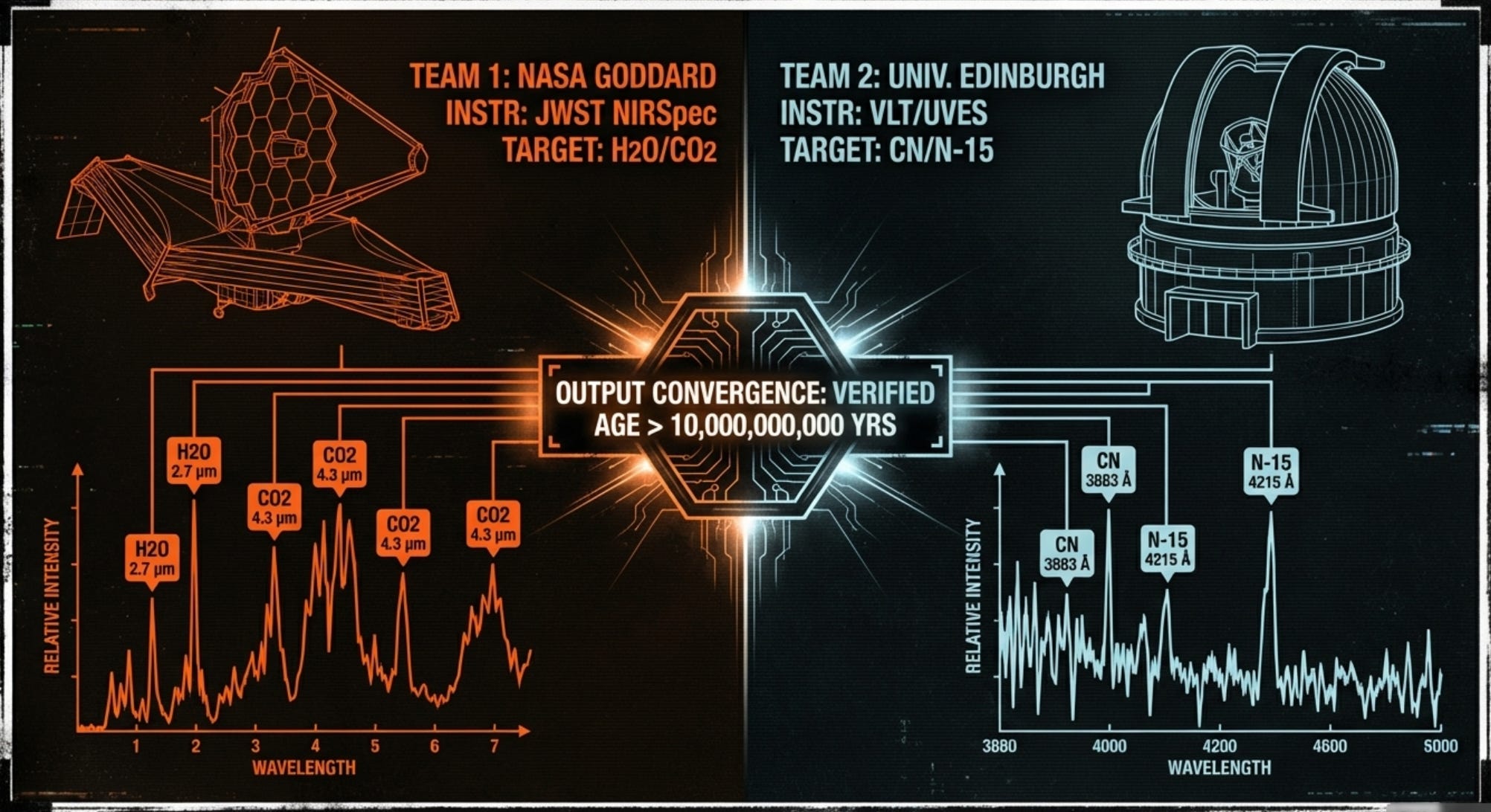
On March 6, a team led by Martin Cordiner at NASA Goddard published their results. The paper. Nineteen authors. In review at Nature. They used the NIRSpec instrument on the James Webb Space Telescope, the most powerful infrared spectrograph ever built, to measure the deuterium-to-hydrogen ratio in 3I’s water vapor.
D/H = 0.95 percent.
Not at the high end of the distribution. Not even close. More than ten times above the ceiling. Off the chart entirely.
The data suggests 3I/ATLAS formed at temperatures barely above absolute zero. In a dense, shielded cloud where the heavy version of hydrogen preferentially stuck to oxygen while the lighter version escaped. An environment where ice formed once and never melted. No mixing. No recycling. No reprocessing.
Nothing in our solar system produces this number. Nothing in any nearby star system produces it either.
HOW OLD
The same JWST observations captured something else: the carbon isotope ratios in 3I’s CO2 and CO.
Here is why that matters. Stars are factories. When they live and die, they scatter heavier elements into the surrounding gas. One of those elements is Carbon-13, the heavy isotope of carbon. Every generation of stars that burns out adds a little more Carbon-13 to the galaxy's supply. So material that formed early, when the galaxy was young and fewer stars had lived and died, locked in very little Carbon-13. Material forming now gets a lot more. You can date the sample the same way you date a tree: count the layers.
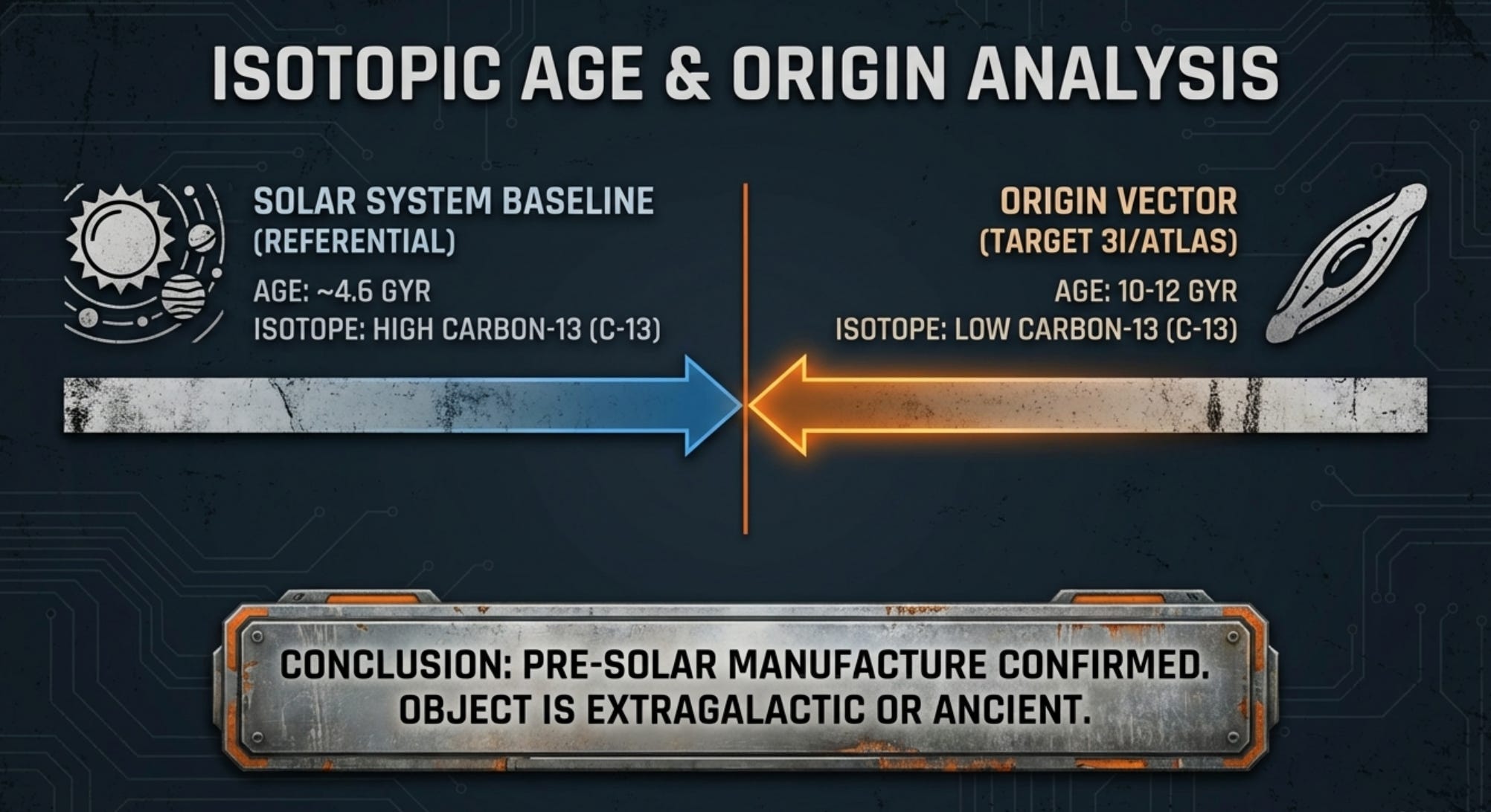
3I has very little Carbon-13. Less than our solar system. Less than nearby gas clouds. Less than the young disks forming around new stars right now.
Cordiner’s team ran the numbers through galactic chemical evolution models. The age: 10 to 12 billion years old.
The Sun is 4.6 billion years old. 3I's ice predates it by more than double. When the gas cloud that became our solar system first started collapsing, this material was already older than we are now.
THE SECOND OPINION
If one team gets an extraordinary result, you need a second team using different equipment to confirm or deny it.
The day after Cordiner published, that team showed up. The paper. Led by Cyrielle Opitom at the University of Edinburgh. Sixteen authors. Completely different instrument: the UVES spectrograph on the Very Large Telescope in Chile’s Atacama Desert. Completely different molecules: they measured carbon and nitrogen ratios from cyanide gas, not water.
Same conclusion.
Their nitrogen-14 to nitrogen-15 ratio came back more than double what solar system comets show. Their carbon ratio lines up with the JWST finding. Old. Metal-poor. From somewhere else entirely.
Two teams. Two continents. Two instruments. Two different molecules. Same answer.
THE SENTINEL ASSESSMENT:
We have tracked fifty-three anomalies. Trajectory. Chemistry. Structure. Jet dynamics. Institutional response. None of them told us when.
Now we know. The data suggests 3I’s building blocks formed before most of the stars you can see from your backyard tonight. In conditions that do not exist anywhere in our solar neighborhood. That material sat frozen at near-absolute-zero in interstellar space for ten billion years.
Then it hit perihelion. And the chemical profile that came out the other side does not match the one that went in.
PART TWO: THE TRANSFORMATION
THE GAP IN THE RECORD
We have been tracking 3I’s post-perihelion behavior for months through every available lens.
The December Intersection documented what happened at closest approach: a 400,000-kilometer X-ray halo and water production rates that made no sense for the size of the nucleus.
The Heartbeat caught the jet system up close: three nozzles at 120-degree separation, wobbling on harmonic periods, holding a tight configuration for four nights before abruptly switching modes on December 27.
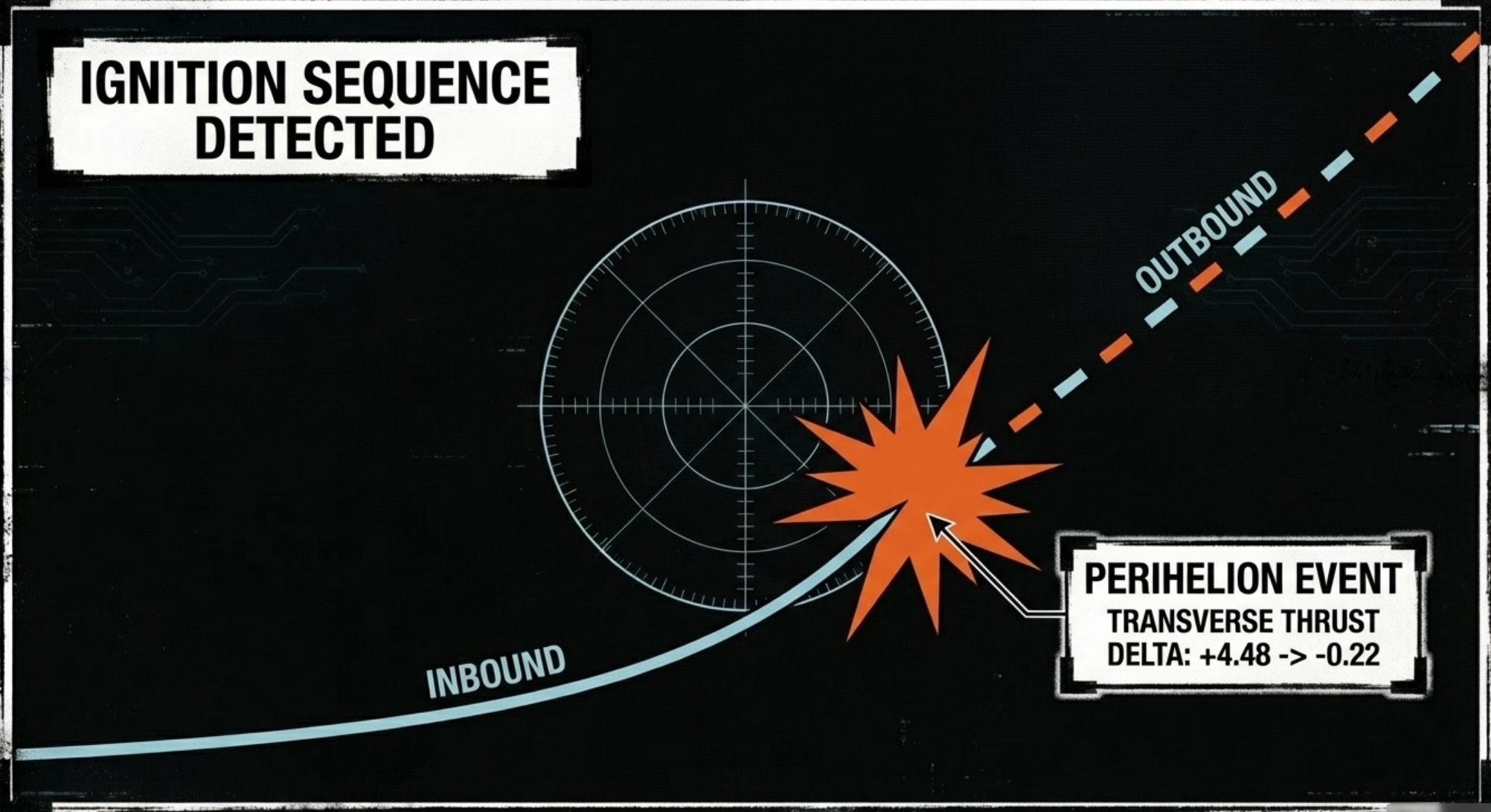
The Curated Orbit measured the force those jets produced and found the transverse thrust flipped sign at perihelion, with a braking peak seven days before closest approach.
Dossier 001 predicted that Oberth maneuver in December.
Structure. Dynamics. Light. We had all three on the outbound leg.
What we did not have was the chemistry. Not just a snapshot here or there. A sustained record of what 3I was actually producing as it pulled away from the Sun, tracked consistently across the entire outbound arc.
A team from the Chinese Academy of Sciences and Yunnan Observatories just filled that gap. The paper. Seven authors. Two ground-based telescopes: the Xinglong 2.16-meter near Beijing and the Lijiang 2.4-meter in Yunnan province. Twelve observation epochs from December 2 through January 20, covering heliocentric distances from 1.85 to 3.29 AU on the way out. Six chemical species tracked at every visit: CN, C3, C2, CH, iron, and nickel.
What did they find? The outbound chemical profile does not match the inbound profile.
THE SLOW FADE
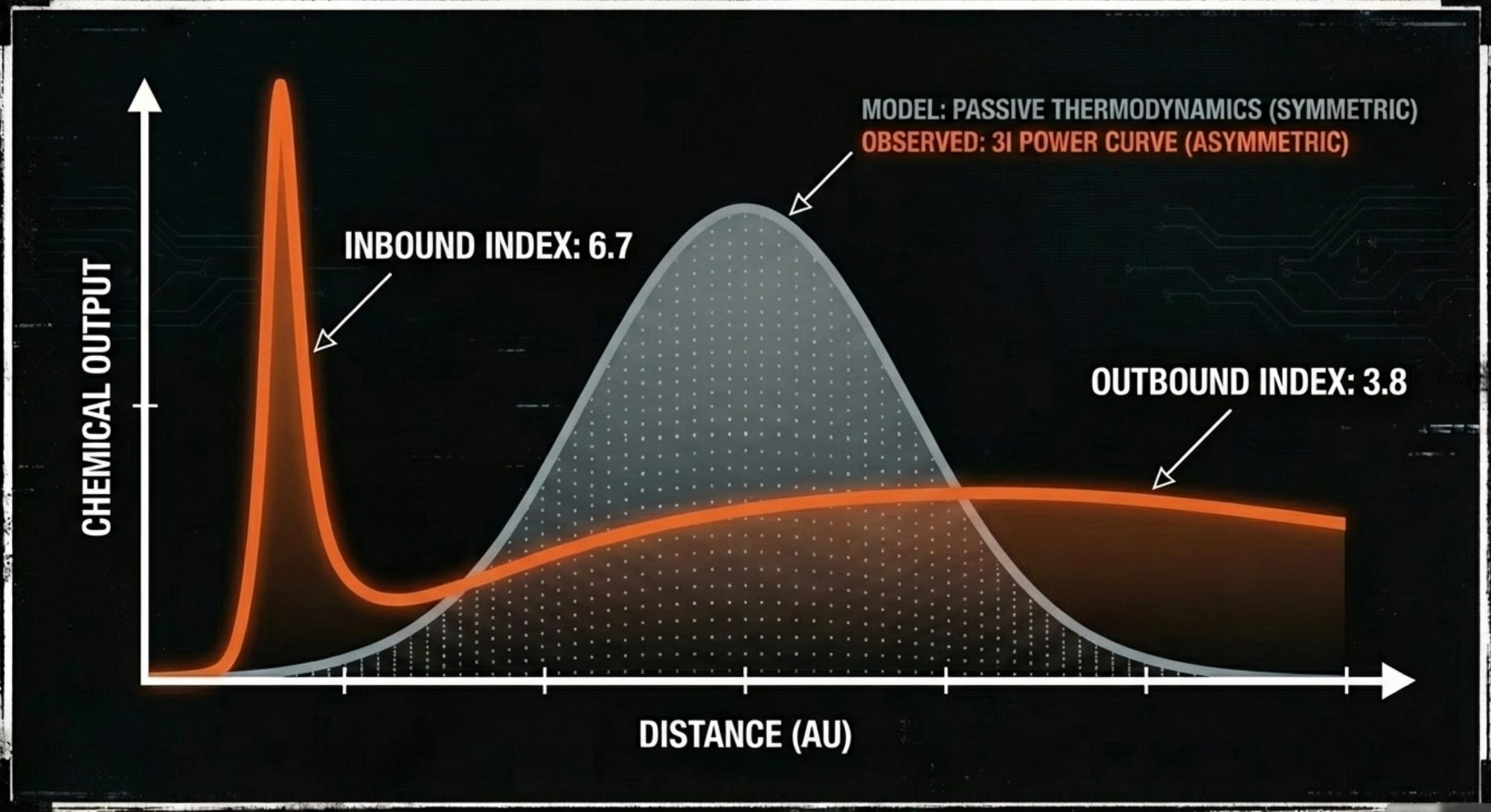
Your oven gets to 400 degrees in ten minutes. Turn it off and it takes an hour to cool. The heating curve and the cooling curve are not the same shape. That is what 3I did with cyanide gas.
On the inbound leg, CN production ramped at a power-law index of 6.7. That is the activation Korea’s 7DT caught igniting at 2.97 AU on August 17. On the outbound leg, CN fades at 3.8. Nearly half as steep.
Water follows the same pattern. Inbound: 5.9. Outbound: 3.3.
If this object were a melting snowball reacting passively to solar heating, the activation and deactivation curves should roughly mirror each other. The Sun heats the surface on the way in. The surface cools on the way out. Symmetric input, symmetric output. That is not what happened. 3I powered up fast and is powering down slow.
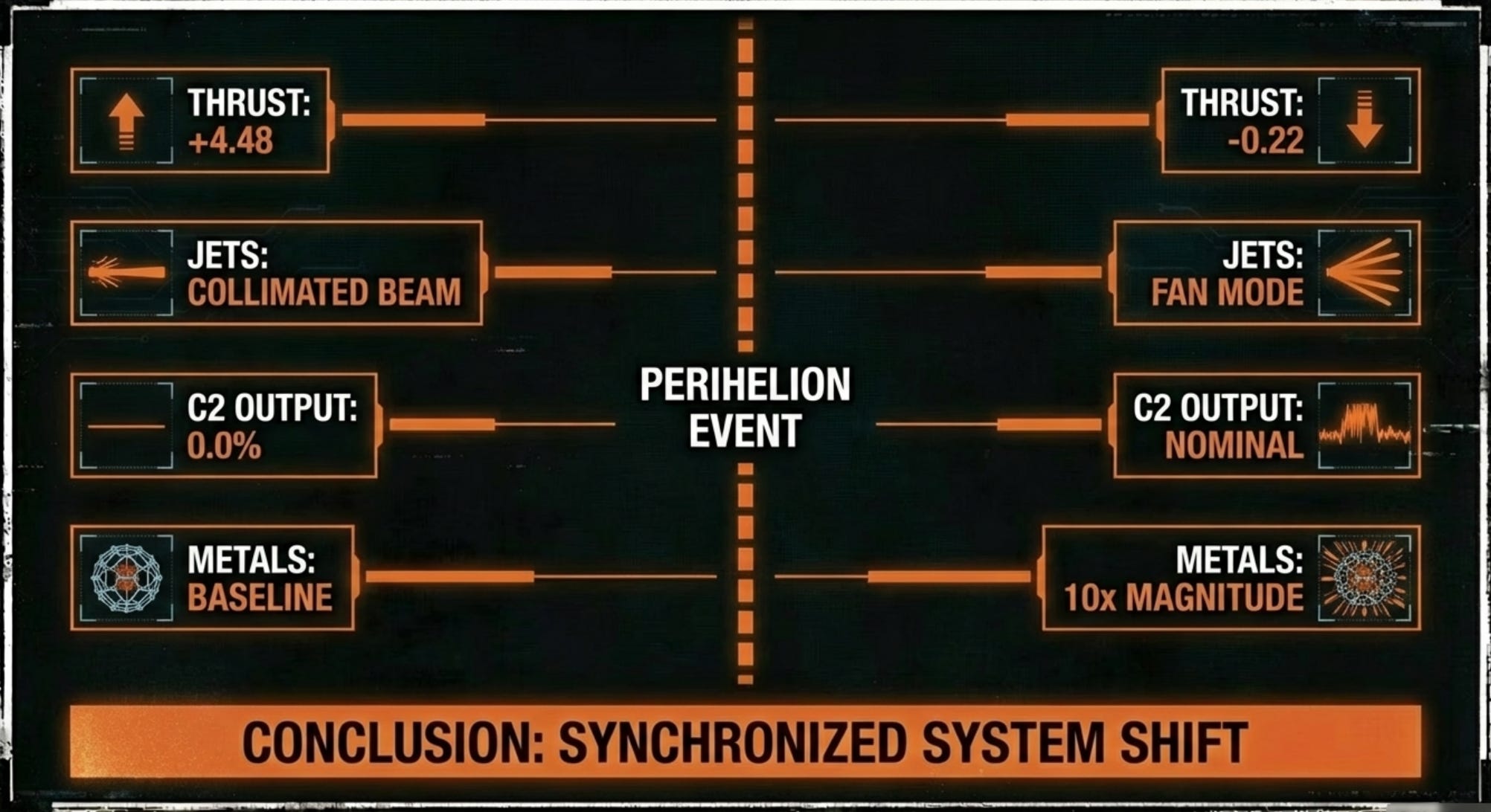
This makes three independent measurement domains showing a break at perihelion. The Curated Orbit documented the transverse thrust flipping from +4.48 to -0.22 at the turn. The Heartbeat documented the jet system switching from collimated beams to fans on December 27. Now the chemistry confirms the same discontinuity from a completely independent domain.
Thrust. Jets. Chemistry. Three teams on three continents measuring three different properties. All three point to the same event. The turn around the Sun. No team references the other two.

THE METAL SURGE
Here is the finding that should be getting more attention than it is.
The outbound iron and nickel production rates are roughly ten times higher than those measured at comparable distances during the inbound approach. Not ten percent. Ten times.
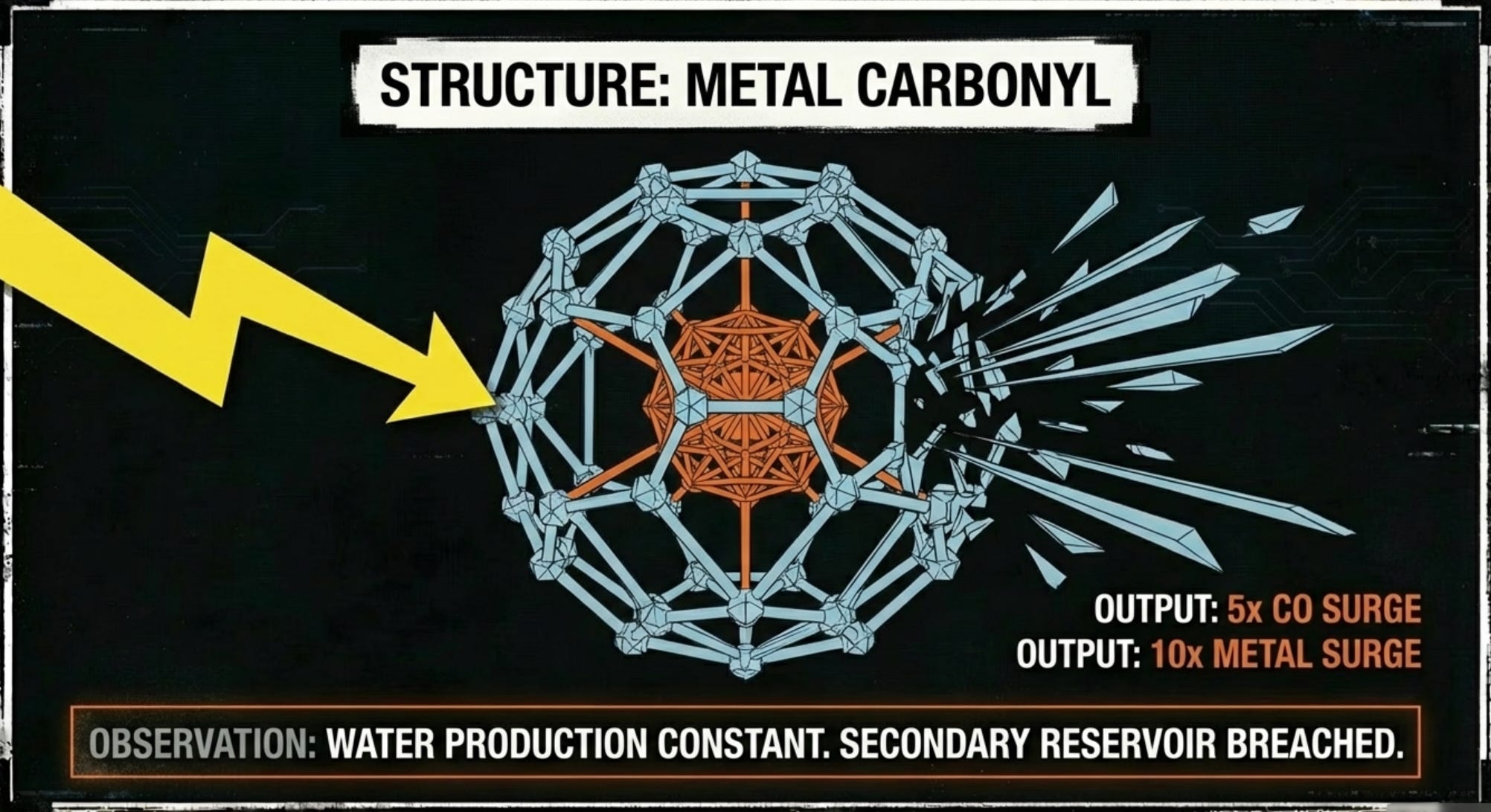
Water production stayed about the same. The coma did not get uniformly brighter. It got selectively metal-rich. 3I came out of perihelion outputting the same amount of water but an order of magnitude more metal.
We flagged the metal behavior early. The Sentinel Dossier documented a clean pattern on the inbound leg: nickel appeared first because it vaporizes at a lower temperature, iron followed as the heat increased, and the ratio between them tracked the thermal gradient like a thermometer. Simple. Predictable. The kind of result that makes a comet look like a comet.
On the outbound leg, that thermometer broke. At 1.509 AU, Hoogendam et al. found iron dominant over nickel. The metal that needs more heat to vaporize was now leading. Zhao’s team flags the same reversal across their twelve epochs. Nobody explains it.
Here is the part that should bother you. The Curated Orbit showed that three different mathematical models fit the nucleus equally well, producing radii from 1.5 to 3 kilometers. Nobody knows how big this thing is within a factor of two. The explanation for a tenfold metal surge is “different layers inside the nucleus.” They are describing the interior of an object whose exterior they cannot measure.
THE CHEMICAL THAT WASN’T THERE
This is the one we called.
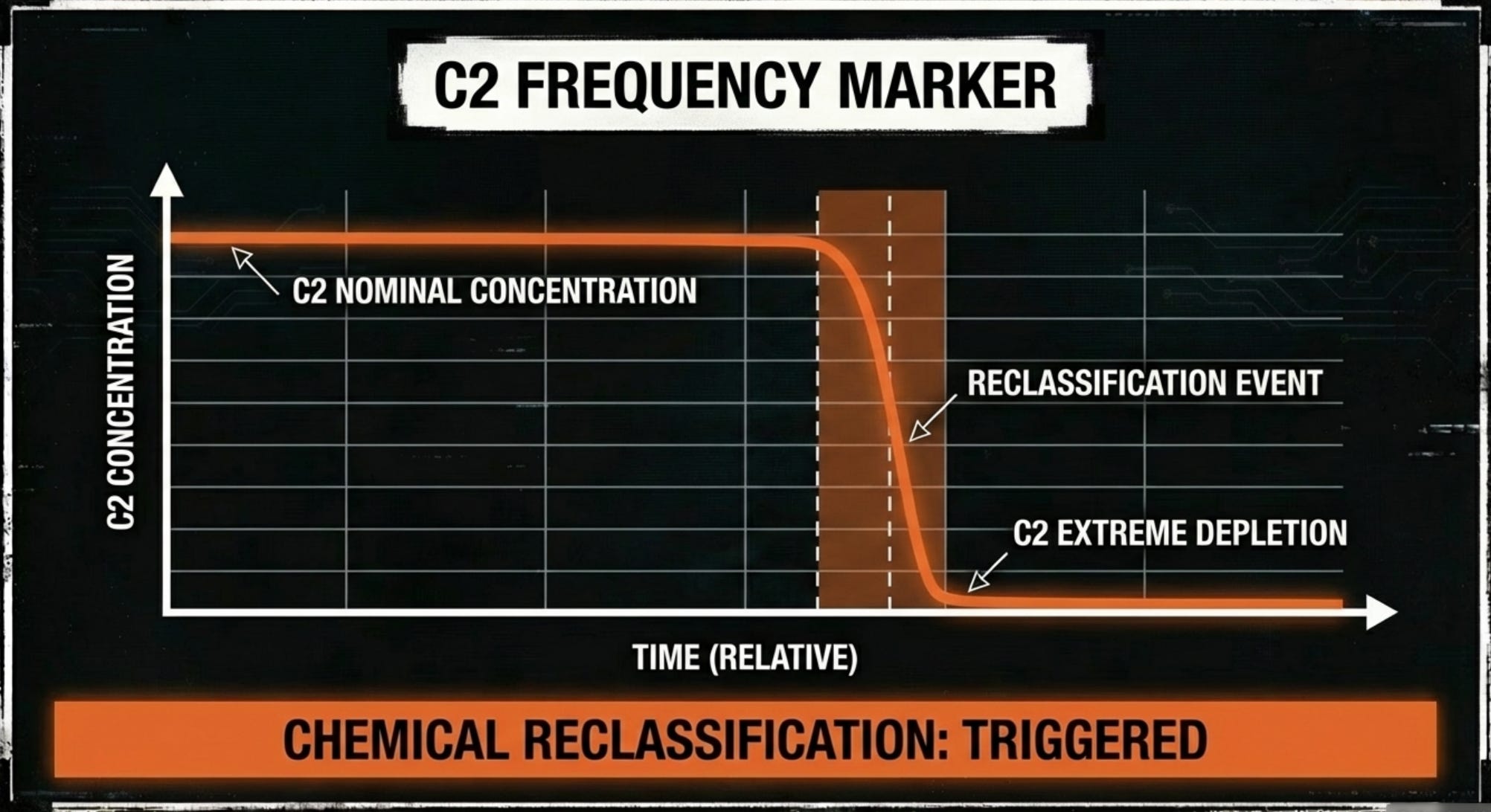
In The Wide Angle, we analyzed Princeton’s HATPI observations and flagged something buried in their data: C2, the diatomic carbon molecule, was completely absent from 3I’s inbound envelope. Korea confirmed the same thing. Fourteen nights. Twenty filters. Nothing but cyanide gas. 3I was classified as one of the most carbon-chain depleted objects ever observed.
Then Princeton noted that their post-perihelion data showed C2 had “suddenly appeared.”
We wrote: “A new chemical appearing after the peak heat implies a secondary system engaging on the way out.”
Zhao’s paper confirms it with systematic data. Before perihelion: extreme C2 depletion. After perihelion: near-normal levels. At some measurements, 3I would be reclassified from “extreme outlier” into the “typical” class for solar system comets.
C2 was absent during the entire approach. It materialized during the retreat at concentrations high enough to reclassify the object.
That is now five stages in the activation sequence we have been building across The Ignition Sequence, The SPHEREx Intercept, and The Wide Angle. Dark mode beyond 3 AU. CN at 2.97 AU. Water at 2.7 AU. CO2 dominance confirmed by SPHEREx. And now, post-perihelion, a chemical reclassification. Each stage at a different distance.
THE HIDDEN RESERVOIR
The authors buried their most interesting finding in Section 3.3, hedged with more caveats per sentence than anything else in the paper. After perihelion, both carbon monoxide and metals surged relative to water. CO jumped roughly fivefold. Metals jumped tenfold. Meanwhile, water production stayed about the same across the turn. When two chemicals spike in lockstep while a third holds steady, the standard interpretation is a common source producing both outputs simultaneously.
The suspect is a metal carbonyl, a molecule where a metal atom sits packaged inside a shell of carbon monoxide. When sunlight breaks it apart, you get metal atoms and CO released at the same time. If the metals have been riding CO the entire time, then the tenfold metal surge and the fivefold CO surge are not two separate anomalies requiring two separate explanations. They are one reservoir cracking open after perihelion. That specific CO-metal correlation has only been observed in two other objects in history: the chemically peculiar comet C/2016 R2 and the previous interstellar visitor 2I/Borisov.
The fivefold CO number is almost certainly an undercount. The Ghost Coma proved that 80 to 90 percent of water production comes from an extended source outside the nucleus. The Wide Angle independently showed a 12-sigma discrepancy between narrow and wide aperture measurements: the more sky you capture, the more signal you find. Zhao’s team used a narrow slit, and they acknowledge the limitation explicitly. That fivefold ratio is a floor, not a ceiling. The actual number could be significantly higher.
THE SENTINEL ASSESSMENT:
The 10-billion-year-old material from Part One just showed a different chemical face after perihelion. Ten times more metals. A new carbon species. CO potentially quintupled. An asymmetric power curve that does not mirror solar heating. And the thrust, the jets, and the chemistry all shifted at the same time.
The authors attribute every one of these findings to “subsurface heterogeneity.” Perihelion heated a new layer. One mechanism. Five independent chemical shifts.
We are not dismissing that explanation. We are asking a question instead.
This material has been frozen at near-absolute-zero for ten billion years in interstellar space. What process organized chemically distinct layers inside it? What thermal history produces a stratified interior inside a body that has been colder than anything in our solar system for longer than our solar system has existed?
PART THREE: THE MASS BUDGET
THE MATH NOBODY ELSE RAN
Avi Loeb read the isotope papers from Part One and asked the question nobody else had put in print. If 3I came from old, metal-poor stars, are there enough of those stars with enough raw material to produce the number of objects the detection rate implies? The paper. Single author. Harvard.
Start with the source. The isotopes point to stars that formed 10 to 12 billion years ago, when the galaxy was young and heavy elements were scarce. Those stars are poor in carbon, oxygen, nitrogen, iron. The raw ingredients of comets. They make up roughly a tenth of the stars in our region of the Milky Way, and they do not have a lot of building material to spare.
Now work from the other direction. We detected 3I. Based on that detection and the Hubble estimate of its size, you can calculate how many objects like it should be drifting through interstellar space to produce the rate we are seeing. Multiply that population by the estimated mass of each one. You get the total amount of material that has to be locked up in this fleet.
That total is roughly twenty times more than all the heavy elements contained in every low-metallicity star in the solar neighborhood combined.
And it gets worse. Stars do not turn all their heavy elements into comets. Most of it stays in the star. Planetary disks, where comets form, contain at least ten times less mass than the star itself. And you would not expect every ejected object to be exactly 3I’s size. The population should contain a lot more total mass spread across a range of sizes. Factor those corrections in and the shortfall reaches three orders of magnitude.
A factor of a thousand. The stars that the isotopes point to would need to convert a thousand times more heavy elements into interstellar objects than they actually contain. The budget is not close. It is not even in the same neighborhood.
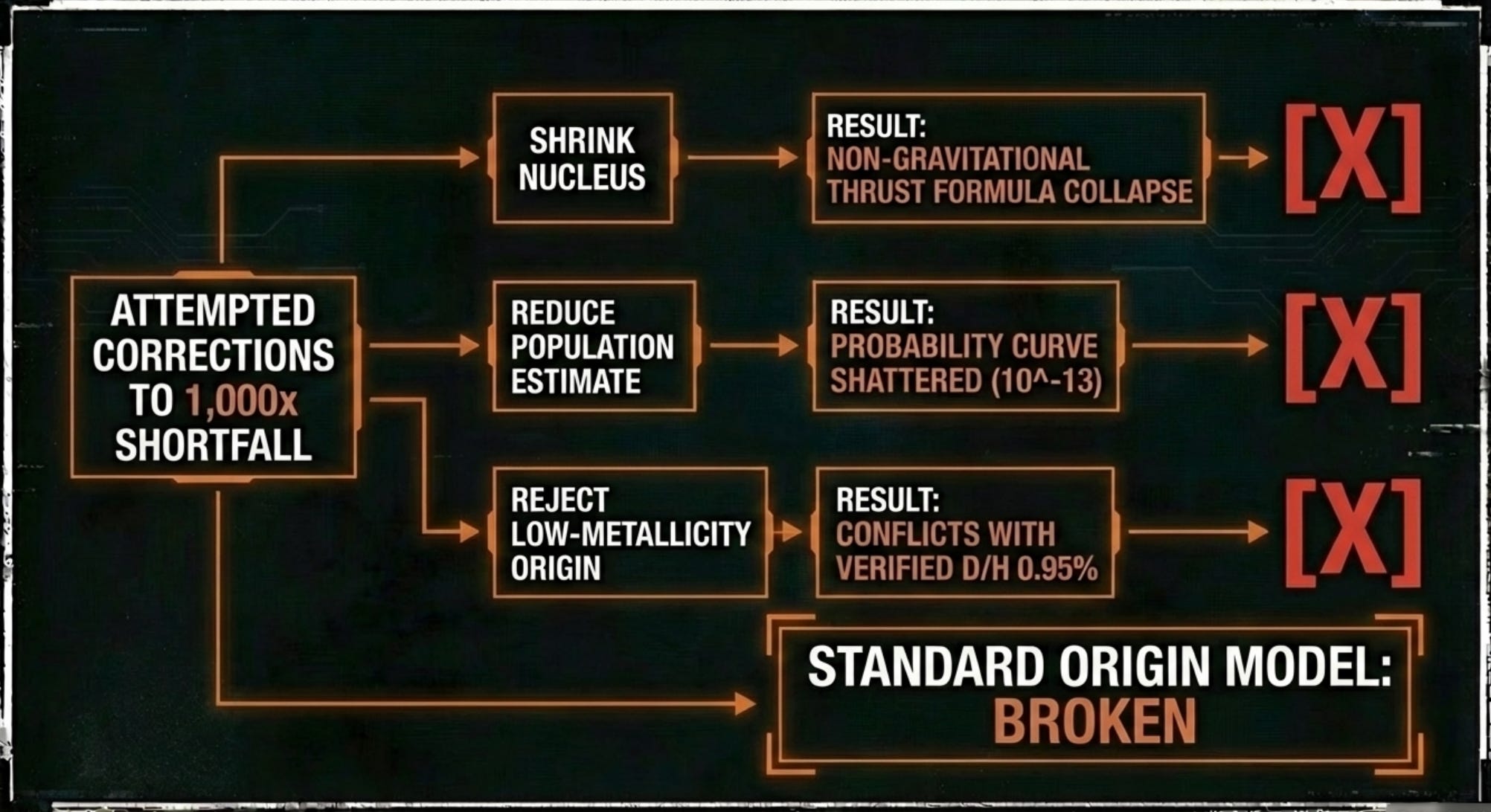
Loeb frames this as a fork with three prongs. Either the nucleus is smaller than we think. Or there are fewer objects out there than we think. Or the low-metallicity origin is wrong.
Every prong is a problem.
THE SENTINEL ASSESSMENT:
If the nucleus is smaller: The Curated Orbit documented 50 percent size uncertainty across three degenerate models. A smaller nucleus eases the budget. But it also means each kilogram of body is being pushed harder by the non-gravitational acceleration. The cometary outgassing model already struggles to produce the measured thrust. Shrink the body and the fit gets worse. One problem solved, another explodes.
If there are fewer objects: The Surge calculated the probability of zero 3I-class objects passing through the inner solar system between the 1990s and 2017 at 10^-13. That number implied a Ghost Fleet. If the population is actually much smaller, that calculation needs fundamental revision. But three interstellar objects detected in eight years is already hard to reconcile with a dramatically lower rate.
If the metal-poor origin is wrong: Then two independent teams using two of the most powerful instruments on Earth produced isotope measurements that converge on an environment that does not exist. The deuterium number is real. The carbon ratios are real. The nitrogen ratio is real. If the origin is not a low-metallicity star, the question becomes: what environment produces D/H = 0.95 percent? Nothing in the current catalog matches.
Every branch hits the same wall. The standard model of interstellar object origins does not accommodate this data.
Jupiter
Here is the operational picture as of right now.
3I’s building blocks are 10 to 12 billion years old. The deuterium timestamp reads ten times above anything in our solar system. The carbon and nitrogen ratios point to a metal-poor environment that has not existed in our galactic neighborhood for billions of years. Two teams. Two continents. Two instruments. Two different molecules. Same answer.
The outbound chemistry does not match the inbound chemistry. Ten times more metals. A carbon species we predicted would appear. CO potentially quintupled. An asymmetric shutdown that does not mirror the activation. The thrust reversed at perihelion. The jets reconfigured in the same window. Three independent measurement domains. Same inflection point.
The mass budget does not close. The proposed source population is short by a factor of a thousand. Every fix breaks something else.
The orbital dynamics remain contested. 7,578 observations reveal a transverse force equal to the radial one. NASA used 782. The transverse signal disappears. The nucleus remains invisible behind its own output. 80 to 90 percent of water production originates from a source that has never been directly imaged. 99 percent of the light is exhaust. The exterior brightens faster than the interior. The jets pulse on harmonics and switch modes. Nobody can determine the size of the body producing all of it.
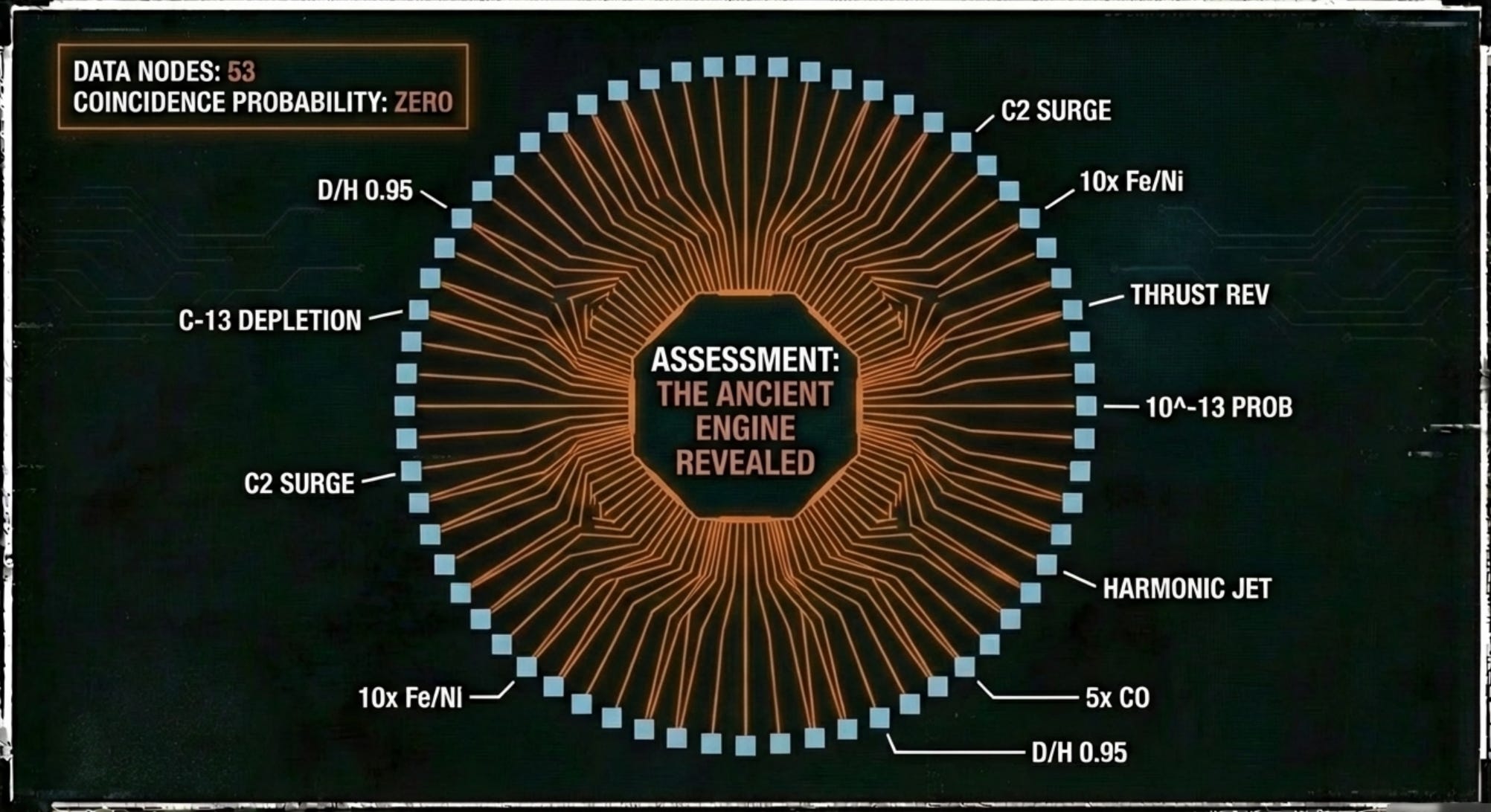
Fifty-three plus anomalies. Twenty-seven plus briefings. Every paper adds to the stack. Every team stays in their lane. Nobody connects the isotopes to the chemistry to the dynamics to the imaging to the institutional response.
That is our job.
4 days to Jupiter.
Keep looking up.
— The Sentinel Network
Sentinel Note: We hate paywalls as much as you do. Every article we’ve published is free and we plan to keep it that way. That’s not changing. But this publication has no institutional backing, no sponsors, and no editorial board. We’re a small team doing the work that the newsrooms won’t. Sourcing papers, filing FOIAs, building tools, and writing at a pace that keeps up with a once-in-a-civilization event. If you can subscribe, you’re funding independent investigation with no strings attached. If you can’t, we don’t care. Read everything. Share everything. The mission is the mission.
Share this briefing. The Suppression Gradient documented what happens when this coverage reaches platforms that don’t want you reading it. Every share, every restack, every forwarded link is a data point against the gradient.
Papers analyzed: Cordiner et al. 2026 | Opitom et al. 2026 | Zhao et al. 2026 | Loeb 2026
If you see something we missed, or something we got wrong, we want your data.
Previous briefings: Dossier 001 | The Sentinel Dossier | Launch Anomaly: Project Square | The Collimation Paradox | The December Intersection | The SPHEREx Intercept | The Glomar Confirmation | SITREP: The Pacific Diversion | The Three Days of Darkness | The Surge | The Silent Edit | CONFIRMED: The TESS Contingency | The Suppression Gradient | The Ghost Coma | The Heartbeat | The Ignition Sequence | Forensic Audit | Project Glass-Hound | The Wide Angle | The Curated Orbit | The Ghost General
I thought Jupiter was the 16th, not tomorrow?
So, is it a directed “natural” object, then? Might mechanisms (or methods) to manage the trajectory of the nucleus occur in the ghost coma? Maybe that’s plasma? Just thinking out loud…