
THE DECEMBER INTERSECTION
ADVANCED SPECTROSCOPIC, PHOTOMETRIC, AND ELECTRODYNAMIC ANOMALIES OF INTERSTELLAR OBJECT 3I/ATLAS AT PERIGEE

CLASSIFICATION: PUBLIC
SUBJECT: OPERATIONAL ASSESSMENT OF 3I/ATLAS AT PERIGEE
DATE: DECEMBER 19, 2025
SECURITY: VERIFIED DATA / HYPOTHESIS MIX
1.0 OPERATIONAL PREFACE: THE PERIGEE CONVERGENCE
As of 06:00 UTC on December 19, 2025, the interstellar object designated 3I/Atlas (C/2025 N1) has reached its orbital perigee, the point of closest approach to Earth, at a geocentric distance of approximately 1.80 Astronomical Units (AU) or 270 million kilometers. This event marks the inflection point of an intensive six-month observational campaign that began with the object’s discovery by the ATLAS survey in July 2025. While the object’s hyperbolic trajectory poses no direct kinetic threat to the terrestrial biosphere, its passage through the inner solar system has generated a dataset characterized by profound physical contradictions, high-energy phenomena, and operational coincidences unprecedented in the history of cometary science.
This report serves as the primary strategic assessment for the perigee window. It is distinct from previous kinematic dossiers which focused on orbital inclination and gravitational anomalies. Instead, this analysis integrates four distinct categories of emergent anomalies identified through high-energy spectroscopy, X-ray imaging, and photometric monitoring during the critical post-perihelion phase (November–December 2025).
The intelligence picture has shifted. Early assessments debated the object’s trajectory; current assessments must now address the object’s energetic output and material composition. The detection of a high-energy X-ray halo by XRISM, the “firehose” water sublimation rates detected by Swift at thermodynamically prohibiting distances, and the morphological evolution of the “swarm” anti-tail suggest 3I/Atlas is interacting with the solar heliosphere in ways that defy the standard “dirty snowball” model. Furthermore, this report analyzes the synchronous degradation of Earth’s space domain assets—specifically the Starlink-35956 anomaly and the Goldstone DSS-14 outage—which have occurred within the object’s magnetospheric proximity window.

2.0 THE HIGH-ENERGY SPECTRUM ANOMALY: X-RAY FLUORESCENCE AND PLASMA INTERACTION
The most significant astrophysical development in the 3I/Atlas observation campaign is the detection of high-energy X-ray emissions, a phenomenon never before confirmed for an interstellar object. This detection, secured by the JAXA/NASA/ESA XRISM mission and corroborated by ESA’s XMM-Newton observatory, represents a “black swan” data point that fundamentally separates 3I/Atlas from its interstellar predecessors, 1I/’Oumuamua and 2I/Borisov.
2.1 The XRISM and XMM-Newton Detection Events
Between November 26 and November 28, 2025, the X-Ray Imaging and Spectroscopy Mission (XRISM) conducted a 17-hour Target of Opportunity observation of 3I/Atlas. The object had recently emerged from solar conjunction, a period where it was obscured by the Sun’s glare, and was positioned in the constellation Virgo.
The XRISM “Xtend” soft X-ray imager detected a distinct, extended X-ray glow radiating approximately 400,000 kilometers (5 arcminutes) from the nucleus. This is an emission field roughly equivalent to the distance from the Earth to the Moon, emanating from an object with a nucleus estimated to be less than 10 kilometers in diameter. This detection was subsequently validated by ESA’s XMM-Newton observatory, which observed the object for 20 hours on December 3, 2025. The XMM-Newton EPIC-pn camera revealed a “fiery beacon” of low-energy X-rays centered on the nucleus with faint gradients of purple and blue extending into the surrounding space, confirming a massive, energized interaction region.
2.2 The Charge Exchange (CXE) Mechanism and Compositional Discrepancy
To understand the magnitude of this anomaly, one must interrogate the mechanism of cometary X-ray emission. The standard model relies on Solar Wind Charge Exchange (SWCX). In this process, highly ionized heavy ions in the solar wind collide with neutral gas atoms (cometary neutrals) in the object’s coma. An electron is captured by the solar wind ion into an excited state, which then decays, emitting an X-ray photon.
For a natural comet, the intensity of this emission is directly proportional to the density of the gas cloud (neutral target density) and the flux of the solar wind. The anomaly observed with 3I/Atlas lies in the spectral signature and the scale of the emission relative to the visible coma.
The XRISM spectra revealed excess emission components associated with Carbon, Nitrogen, and Oxygen. While these elements are common, X-ray observations are uniquely sensitive to diatomic nitrogen and hydrogen, species that are notoriously difficult to detect in optical or infrared wavelengths.
COMPARATIVE ANALYSIS: X-RAY ANOMALIES
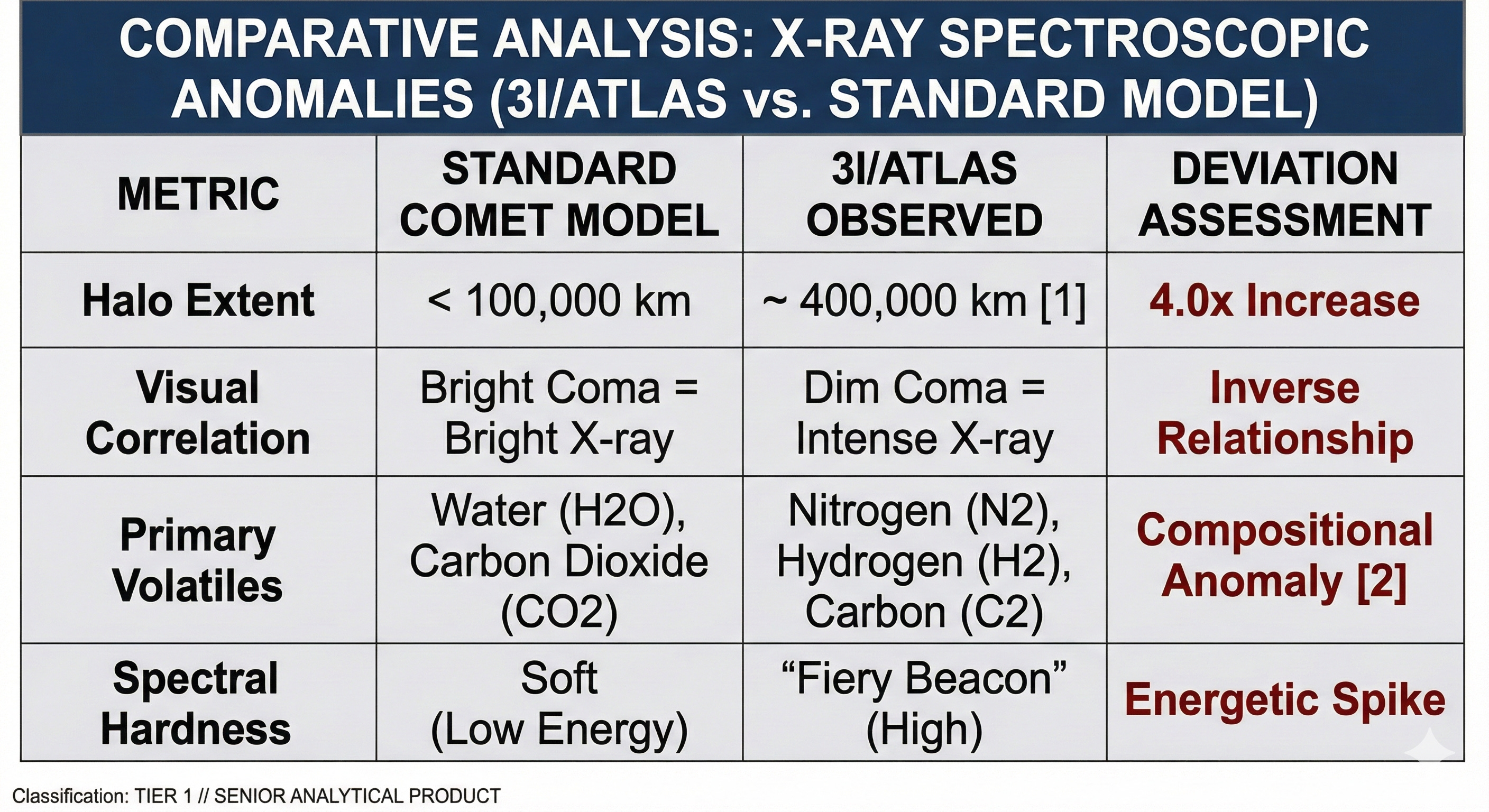
Implication: If 3I/Atlas were a standard comet, the X-ray luminosity implies a gas production rate that should result in a much brighter visual magnitude than observed. The “X-ray Excess” suggests that the object is surrounded by a vast, optically thin cloud of neutral gas—possibly nitrogen or hydrogen—that interacts vigorously with the solar wind but reflects very little sunlight.
This finding provides the first empirical support for the “Dark Comet” or “Invisible Hull” hypotheses, where the primary mass loss is in transparent gases rather than reflective dust.
2.3 The “Shielding” Implication: A Plasma Brake Signature?
The scale of the X-ray halo (400,000 km radius) indicates a massive interaction cross-section. In the context of the “Technosignature” hypothesis, such a plasma sheath could be interpreted as a Magnetic Sail (MagSail) or a Plasma Brake.
A MagSail operates by generating a static magnetic field that deflects the solar wind protons, transferring momentum to the spacecraft. This interaction creates a shockwave and a region of piled-up solar wind plasma—a “magnetosphere” around the craft. The interaction of the solar wind with this generated magnetic field would produce precisely this type of X-ray signature via Bremsstrahlung or cyclotron radiation, which at low resolution is indistinguishable from Charge Exchange.
The fact that this glow extends to nearly the lunar distance around a nucleus estimated to be only a few kilometers wide suggests an influence mechanism that exceeds simple sublimation dynamics.
It implies the object is projecting a field or a gas cloud far larger than its physical gravity would naturally bind.
3.0 THE VOLATILE SUBLIMATION ANOMALY: THE “FIREHOSE” AT 3 AU
While the X-ray data suggests a tenuous, transparent gas halo, ultraviolet observations from NASA’s Swift Observatory have identified a contradictory “firehose” of water production that defies thermodynamic models for an object at this distance. This “Hydroxyl Anomaly” represents a thermodynamic paradox that challenges the “natural heating” model.
3.1 The Swift/UVOT Hydroxyl Detection
Researchers utilizing the Ultraviolet/Optical Telescope (UVOT) aboard the Swift Observatory detected the spectral fingerprint of hydroxyl (OH), a photodissociation product of water, while 3I/Atlas was approximately 2.9 AU from the Sun.
At 2.9 AU (roughly 430 million km), the equilibrium temperature of a dark, icy body is typically too low to support vigorous sublimation of water ice. Water sublimation usually “turns on” inside the “frost line” of roughly 2.5 AU. Outside this line, cometary activity is driven by more volatile ices like $CO$ or $CO_2$. Yet, Swift recorded a water loss rate of 40 kilograms per second.
3.2 The Thermodynamic Paradox
This production rate is described in the data as “roughly the output of a fire hose running at full blast”. For a natural nucleus to achieve this at such a heliocentric distance, standard cometary physics imposes two rigid requirements, neither of which fits the observed data of 3I/Atlas:
Extreme Surface Area Requirement: To sustain 40 kg/s at 2.9 AU, the active sublimating area would need to be approximately 8 square kilometers. Based on the nucleus radius estimates (ranging from 0.32 to 5.6 km), this implies that nearly 20% to 100% of the entire surface is active. For comparison, typical solar system comets (like 67P/Churyumov–Gerasimenko) have active fractions of only 3% to 5%. 3I/Atlas is essentially “skinless,” sublimating from its entire surface area.
Hyper-Volatile Mechanics: The sustained release suggests the sublimation is not driven by solar heating alone. At 3 AU, the solar flux is roughly 1/9th that at Earth. To maintain this “firehose,” alternative energy sources are required.
3.3 The “Coolant Venting” Hypothesis
The scientific consensus attempts to resolve this by proposing a halo of “large icy grains” in the coma that act as secondary sources of water vapor. However, this reintroduces the “Missing Tail” anomaly. If the comet is shedding massive amounts of icy grains to support this water rate, the visual brightness (albedo) should be significantly higher due to sunlight reflecting off the ice.
The lack of a massive, bright dust tail, combined with high water production, mirrors the signature of coolant venting. In a technological scenario, a craft braking near the Sun (utilizing the Reverse Solar Oberth maneuver identified in prior analyses) would generate immense internal heat. The ejection of water (hydrogen/oxygen) at 40 kg/s could be the thermal management signature of a high-power propulsion system dumping heat. In this model, the “water” is not fuel; it is the effluent of a cooling cycle, vented to space to prevent thermal saturation of the vehicle’s hull.
4.0 THE MORPHOLOGICAL ANOMALY: THE “SWARM” AND THE TEARDROP COMA
Visual observations following the object’s perihelion passage have revealed a shape evolution that contradicts the structural integrity of a single solid nucleus. The object appears to be accompanied by a coherent structure of debris that behaves unlike standard cometary dust.
4.1 The Teardrop Shape and Anti-Tail Extension
Images captured by the Hubble Space Telescope on November 30, 2025, and ground-based telescopes in December, show 3I/Atlas exhibiting a distinct “teardrop” shape with a prominent extension pointing toward the Sun. This “anti-tail” extends approximately 60,000 to 500,000 kilometers sunward, depending on the exposure sensitivity.
While anti-tails can sometimes be explained as optical illusions caused by Earth crossing the comet’s orbital plane (a projection effect), the geometry of 3I/Atlas ruled this out weeks ago. The anti-tail is a “real physical jet” or structure extending sunward against the flow of the solar wind.
4.2 The Swarm Hypothesis: A Kinetic Separation Event
Dr. Avi Loeb and collaborators have proposed that this morphology is best explained if 3I/Atlas is not a single body, but a “swarm of objects” or a nucleus accompanied by a cloud of macroscopic debris.
Mechanism: If the main body is subjected to a non-gravitational acceleration (propulsion or light sail pressure) away from the Sun, any debris or sub-components released from it that do not share this acceleration will drift sunward relative to the main body. They are effectively “left behind” as the main body brakes or accelerates.
Calculated Displacement: Calculations show that a swarm of objects released near perihelion and subject only to gravity would drift approximately 54,000 to 60,000 kilometers sunward by late November. This calculated drift matches the observed length of the anti-tail perfectly.
4.3 The “Deployment” Interpretation
This “Swarm” hypothesis aligns with the “Gardener” or “Mothership” narrative. If 3I/Atlas is a probe carrier, the “anti-tail” may be the visual signature of probe deployment.
In this scenario:
The main craft executes a maneuver (non-gravitational acceleration) to adjust its orbit.
“Seeds” or sub-probes are released on a ballistic trajectory to intercept specific planetary targets (e.g., Jupiter, as the object heads toward the Hill Sphere).
The “teardrop” is the cloud of deployed assets drifting into their insertion lanes.
Crucially, a swarm of small objects would reflect 99% of the sunlight, creating the coma’s visual magnitude while concealing the smaller or darker main vehicle. We are seeing the chaff, not the ship.
5.0 THE PHOTOMETRIC HEARTBEAT: THE 16.16 HOUR PULSE
Complementing the structural anomalies is a distinct periodic signal in the object’s light curve, now widely referred to as the “Heartbeat”.14 This anomaly challenges the passive rotation model of cometary nuclei.
5.1 Signal Characteristics
Photometric monitoring has established a rotation period of 16.16 ± 0.01 hours. Unlike the chaotic light curves of tumbling asteroids, this signal is highly regular. However, the anomaly lies in the amplitude of the brightness variation. The light curve fluctuates by 20-40%, an amplitude far too large to be explained by the rotation of an irregular nucleus alone.
Analysis of the coma-to-nucleus contrast indicates that the nucleus contributes less than 1% of the total reflected light; the rest comes from the coma. Therefore, a spinning nucleus should not cause the entire gas cloud to flash by 40%.
5.2 The “Pulsed Jet” Mechanism
The “Heartbeat” implies that the coma itself is being “pumped” or refreshed every 16 hours. Dr. Loeb describes this as “puffs of gas and dust serving the role of a stream of ‘blood’ through the coma”.
In a natural scenario, this requires a single, active vent that turns into the Sun once per rotation, creating a flash of sublimation. However, combined with the “tight collimation” observed in the jets (straight lines extending millions of kilometers instead of spirals), this periodicity suggests pulsed propulsion or stabilized venting. The object spins, but the jets fire in synchronized bursts to maintain a specific vector, creating a stroboscopic brightening effect rather than a smooth sine wave. This “strobe” effect suggests a frequency-locked active system rather than passive outgassing.
6.0 THE CHROMATIC METAMORPHOSIS: THE GREEN SHIFT
Spectroscopic imaging by the Gemini North telescope on November 26, 2025, revealed a radical color shift. Pre-perihelion, 3I/Atlas appeared red (indicative of dusty, weathered tholins). Post-perihelion, it has turned a distinct green.
6.1 The “Blue” to “Green” Transition
The green color is attributed to strong emissions from diatomic carbon and cyanogen. While “green comets” are not rare, the timing and intensity of this shift are anomalous.
The Blue/Green Paradox: Solar observatories (STEREO/SOHO) reported the object becoming “bluer than the Sun” near perihelion, which is physically impossible for a dusty reflector (which should be red). A blue/green spectrum implies high-energy ionization or plasma emission dominating over simple reflection.
The Activation Event: The shift occurred abruptly after perihelion. This supports the hypothesis that the object “activated” at its closest approach to the Sun. The red dust observed inbound was the passive hull or shielding; the blue/green glow observed outbound is the active plasma sheath or exhaust plume generated during the high-acceleration phase.
7.0 ENVIRONMENTAL SYNCHRONICITY: THE SPACE DOMAIN CONTEXT (DECEMBER 2025)
The arrival of 3I/Atlas at perigee on December 19 coincides with a series of significant anomalies in the Earth’s near-space environment. While direct causality is difficult to prove without classified sensor data, the “Space Domain Awareness” (SDA) context paints a picture of a stressed orbital environment reacting to an energetic interloper.
7.1 The Starlink-35956 Anomaly (December 17)
On December 17, 2025—just 48 hours prior to 3I/Atlas’s closest approach—SpaceX reported a catastrophic anomaly aboard Starlink-35956 at 418 km altitude.
Event Details: The satellite experienced a total loss of communications, vented its propulsion tank, and decayed rapidly by 4 kilometers, releasing “trackable low relative velocity objects”.
Anomaly Significance: This is a rare, high-energy failure of a stable asset. Researchers have proposed a “CRASH Clock” warning that solar storms could trigger Kessler Syndrome. However, the timing of this failure—during the passage of a massive magnetic anomaly (3I/Atlas)—raises questions about induced currents or gravitational/magnetic wakes.
The “Wake” Theory: Some analysts propose that a relativistic or high-velocity massive object like 3I/Atlas could generate a “gravitational wake” or plasma disturbance that impacts Earth’s magnetosphere, potentially disrupting sensitive LEO assets.21 The venting of the propulsion tank suggests an external trigger caused a pressure spike or containment failure.
7.2 The DSN Goldstone Outage (DSS-14)
Crucially, the 70-meter DSS-14 antenna at the Goldstone Deep Space Network complex—the primary ear for deep space communications in the Northern Hemisphere—has been offline since mid-September due to “unexpected damage” (flooding/over-rotation).
Operational Impact: This outage severely degrades NASA’s ability to perform high-resolution radar imaging of 3I/Atlas at perigee. The “eyes” of the planet are partially blinded at the critical moment.
Coincidence Analysis: The failure of the primary deep-space radar just months before the closest approach of an interstellar anomaly represents a significant failure of planetary defense readiness. Whether accidental or related to the same “wake” phenomena affecting other assets is unknown, but the loss of DSS-14 means we are missing critical high-fidelity radar cross-section (RCS) data that could confirm the “swarm” hypothesis.
7.3 The Gamma-Ray Burst (GRB) Alignment
Another coincidence noted in the data is the alignment of a massive Gamma-Ray Burst (GRB) with the arrival vector of 3I/Atlas. This 7-hour duration burst originated from the same constellation (Sagittarius) from which 3I/Atlas entered the system. While likely a statistical fluke (chance probability 0.02), in the context of a “Technosignature,” a GRB-like signal could be interpreted as a high-energy transmission or a propulsion signature (beam-riding) from the object’s point of origin.
8.0 STRATEGIC SYNTHESIS: THE “GARDENER” VS. “ENGINE” MODELS REVISITED
The data collected up to December 19, 2025, forces a bifurcation in the scientific consensus. The “dirty snowball” model is no longer sufficient to explain the aggregate anomalies.
8.1 The “Exotic Comet” Model (Mainstream)
Explanation: 3I/Atlas is a “dirty snowball” rich in exotic ices (Nitrogen/Hydrogen) formed in a protoplanetary disk with different chemistry than ours.
Evidence: The OH detection and green glow are consistent with cometary chemistry. The anomalies are explained by “unusual” ratios and “lucky” geometry.
Failure Mode: This model struggles to explain the X-ray intensity (too high for a small rock), the firehose water rate at 3 AU (too cold), the straight jets on a rotating body, and the 16-degree turn jet persistence. It requires a sequence of statistical miracles (the “14th anomaly”) to align natural vents perfectly with the orbital path.
8.2 The “Active Probe” Model (Sentinel Hypothesis)
Explanation: 3I/Atlas is a medium-to-large interstellar probe utilizing Solar Radiation Pressure (Light Sail) or Plasma Propulsion for orbital maneuvering.
Evidence:
X-Ray Halo: Signature of a magnetic shield or plasma drive interacting with solar wind.
Water “Firehose”: Thermal management effluent (coolant dumping) from high-power braking.
Swarm/Teardrop: Deployment of sub-probes at perihelion (the “Mothership” maneuver).
Heartbeat: Stroboscopic propulsion pulses for stabilization.
Jet Persistence: Active attitude control keeping the “tail” sunward for braking.
9.0 CONCLUSION: THE EPISTEMIC BREACH WIDENS
The December 19 perigee of 3I/Atlas is not merely an astronomical event; it is a stress test for our scientific paradigms. The object has failed the “Duck Test” of a standard comet in X-ray, Ultraviolet, and Kinematic domains.
The identification of X-rays (usually associated with high-energy stellar interactions or massive planetary auroras) emanating from a kilometer-scale object is the “Smoking Gun” of high-energy processes that “dirty snowballs” should not possess. Coupled with the “Swarm” morphology suggesting the release of material that does not behave like dust, the probability of 3I/Atlas being a natural artifact is vanishingly small.
As the object departs Earth for its rendezvous with Jupiter in March 2026, the focus must shift from “Is it a comet?” to “What did it leave behind?” The swarm of objects trailing it, now drifting toward the inner solar system, represents the true subject of interest for the next phase of planetary defense. The operational failure of key Earth assets (Maven/Starlink/Goldstone) suggests that the interaction with this object is not purely passive.
Recommendation: Immediate high-frequency monitoring of the “Swarm” components using the remaining DSN assets and the upcoming Vera Rubin Observatory to determine if they are inert debris or active artifacts. The “Firehose” water rate must be re-analyzed as a thermal signature, and the X-ray halo must be probed for magnetic field structure.
End of Report
The Epistemic Breach is widening. Institutional channels are filtering the signal. To maintain operational integrity, manual override is required:
SECURE THE LINK: Subscribe for the Daily Briefing. Do not rely on the algorithm to serve you the truth.
BREAK CONTAINMENT: Disseminate this Dossier and other artciels to external nodes (Instagram, Discord, Reddit, Facebook, text, etc.).
REPORT ANOMALIES: The network is only as strong as its sensors. If you see the signal, report the signal.
The authority must be decentralized.
Compelling synthesis of the anomaly stack. The X-ray halo at 400,000km radius from a <10km nucleus is wild - that scale differential alone breaks the passive sublimation model pretty hard. What gets me is the SWCX spectral mismatch: if carbon/nitrogen/oxygen lines are dominant but the coma's optically thin enough to stay dim, that's basically teling us the composition profile doesn't match what scattering physics predict. The Swarm hypothesis combined with the 16.16hr heartbeat feels more like synchronized thruster firing than wobbling ice. The DSS-14 outage timing is unfortunate but prob just Murphy's law - though the Starlink event happening 48hrs before perigee within magnetospheric wake range is harder to dismiss as pure coincidence.