
THE IGNITION SEQUENCE: Three Independent Teams Just Mapped the Moment 3I/ATLAS Switched On — And It Connects Everything
Korea caught the ignition. Shanghai heard the scaling. Loeb measured the architecture. Three teams, three wavelengths, one conclusion: the nucleus isn’t doing the work. The timeline is complete.

DATE: FEBRUARY 24, 2026
SUBJECT: FORENSIC ANALYSIS OF ARXIV:2602.12930v1 // PRE-PERIHELION CN GAS COMA EMERGENCE IN 3I/ATLAS — AND THE UNIFIED SENTINEL TIMELINE
CROSS-REF: [THE SENTINEL DOSSIER] | [THE GHOST COMA] | [THE HEARTBEAT] | [THE SURGE] | [THE DECEMBER INTERSECTION] | [CONFIRMED: THE TESS CONTINGENCY] | [THE SUPPRESSION GRADIENT] | [THE SILENT EDIT] | [THE GLOMAR CONFIRMATION]
CLEARANCE: PUBLIC
THIS PAPER CHANGES EVERYTHING
Since December, we’ve been building this investigation one instrument at a time.
The Dossier identified eighteen anomalies.
The Ghost Coma proved the nucleus barely produces water — Shanghai’s radio telescopes found 80-90% of the water comes from some invisible source in the surrounding cloud, not the surface.
The Heartbeat showed the hull is invisible — Loeb found 99% of 3I’s light comes from the jets and gas cloud, not the surface — and those jets pulse on a clock-like rhythm before abruptly changing behavior on December 27.
The Surge revealed the dust bounces light like a solid surface, not a fluffy ice cloud.
The Three Days of Darkness and CONFIRMED documented the TESS blackout.
The Glomar Confirmation proved the CIA classified it.
The Silent Edit caught NASA scrubbing databases.
Each piece was a snapshot. A different team, a different instrument, a different moment in the object’s passage.
What we’ve never had is the timeline. The continuous record showing when each system turned on, in what order, and how the object scaled from dead silent to fully active.
A team from the University of Hawai’i and Seoul National University just posted that timeline to arXiv.
And it connects everything.
THE INSTRUMENT: TWENTY WINDOWS, ONE OBJECT
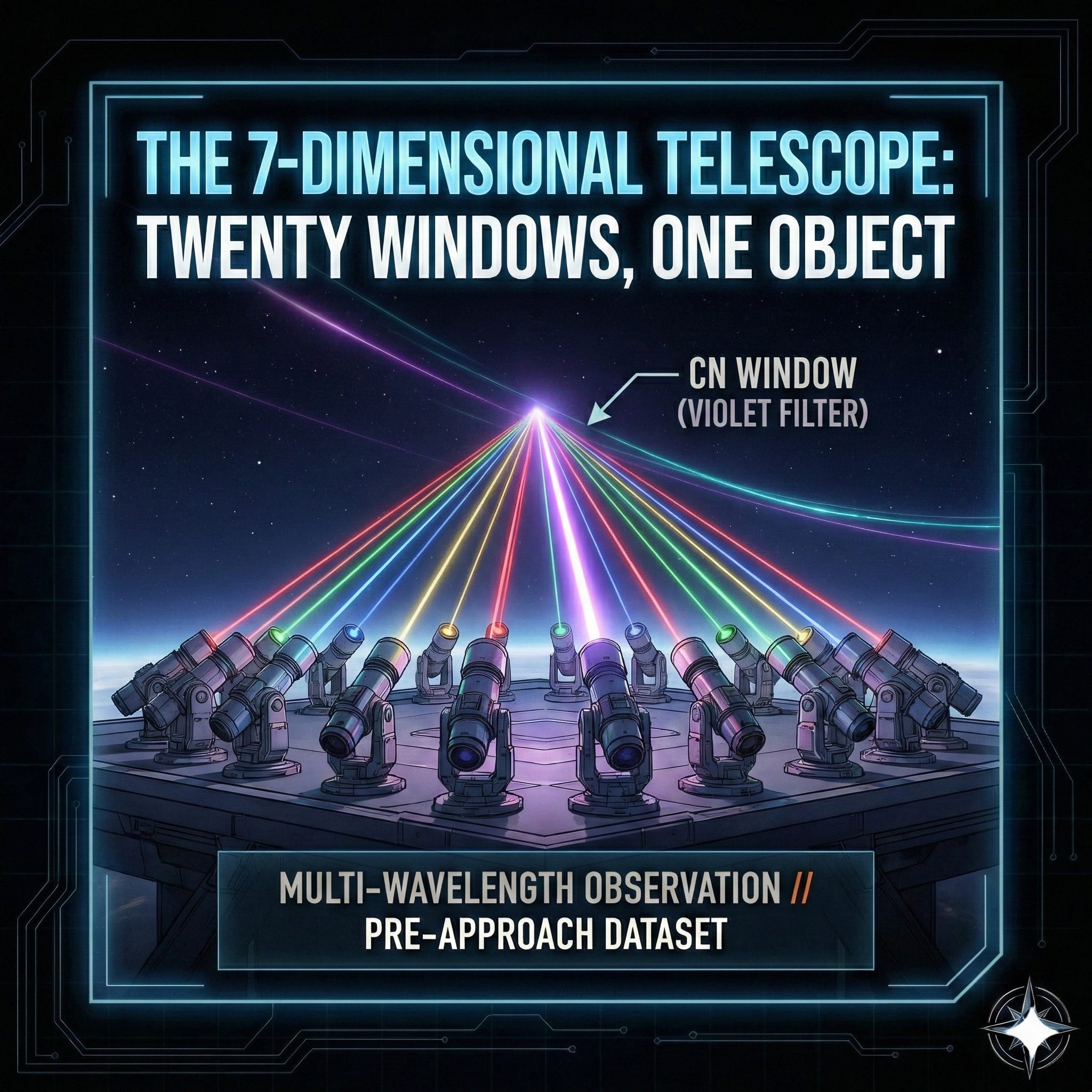
The 7-Dimensional Telescope is not one telescope. It’s twenty. 20 separate telescope units in Chile, each with a different color filter, all pointed at the same target at the same time. As gas burns off, it emits a specific color signature. If the object is emitting any specific chemical signature, at least one of those windows will catch it.
They watched from July 13 to September 18, 2025. Fourteen separate observation nights. They measured light at every distance from 1,500 km to 25,000 km around the nucleus. Close-up to the core and way out into the surrounding cloud.
This is the most detailed pre-approach dataset anyone has published for 3I/ATLAS.
And they caught the moment the object’s gas system turned on.
THE BREAKPOINT: AUGUST 17, 2025
Here’s how you find a mode change.
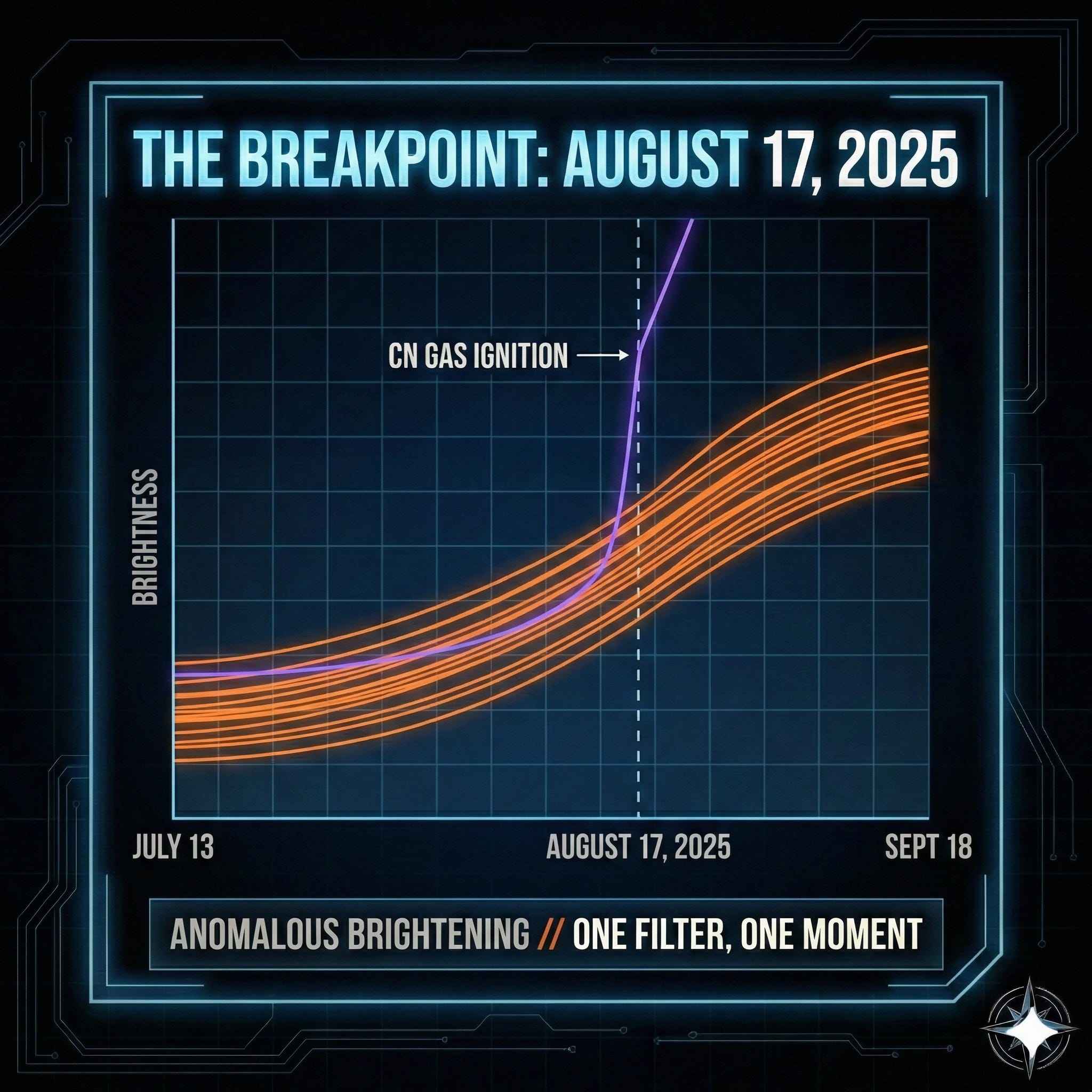
As a comet gets closer to the Sun, it should brighten at roughly the same rate across all colors . More heat means more dust lit up, brighter everywhere. That’s exactly what the team saw across nineteen of their twenty filters. From July to September, 3I/ATLAS brightened on a smooth, predictable curve. Nothing unusual.
Except for the violet filter.
The filter tuned to detect CN gas. A specific molecule that glows violet when energized didn’t follow the others. Instead of a smooth curve, it showed two completely different behaviors separated by a clean break.
Before August 17: The CN window brightened slowly. Quietly tracking the dust, nothing extra.
After August 17: The CN window brightened at more than double the previous rate. It became the fastest-brightening filter on the entire telescope.
The break isn’t gradual. The math pinpoints it to a single date: August 17, 2025 — the day 3I crossed roughly 2.97 AU from the Sun (about three times the Earth-Sun distance, a little beyond Mars).
One filter. One moment. A switch flipped.
THE SENTINEL ASSESSMENT:
Look at the raw data. The 7DT array provided twenty optical data streams. Nineteen of those streams plot a unified, predictable thermal curve as the object approaches the Sun. That is the required baseline for natural heating.
The twentieth stream—the isolated cyanogen band—ignores this baseline completely. It holds flat, crosses the 2.97 AU threshold, and instantly spikes at an anomalous rate.
Ice doesn’t wait for a proximity alarm to start melting. A dead rock warms up smoothly, shedding whatever is on its surface in a messy, overlapping cloud. But a manufactured system operates on rigid thresholds. It hits a specific environmental parameter, engages a specific protocol, and an isolated system comes online. The data isn’t showing a natural object reacting to the sun. It’s showing an exhaust system engaging.
And the timing of that ignition locks perfectly into the sequence we documented last week.
THE SEQUENTIAL STARTUP: CN FIRST, THEN WATER
This is the finding that stopped us.
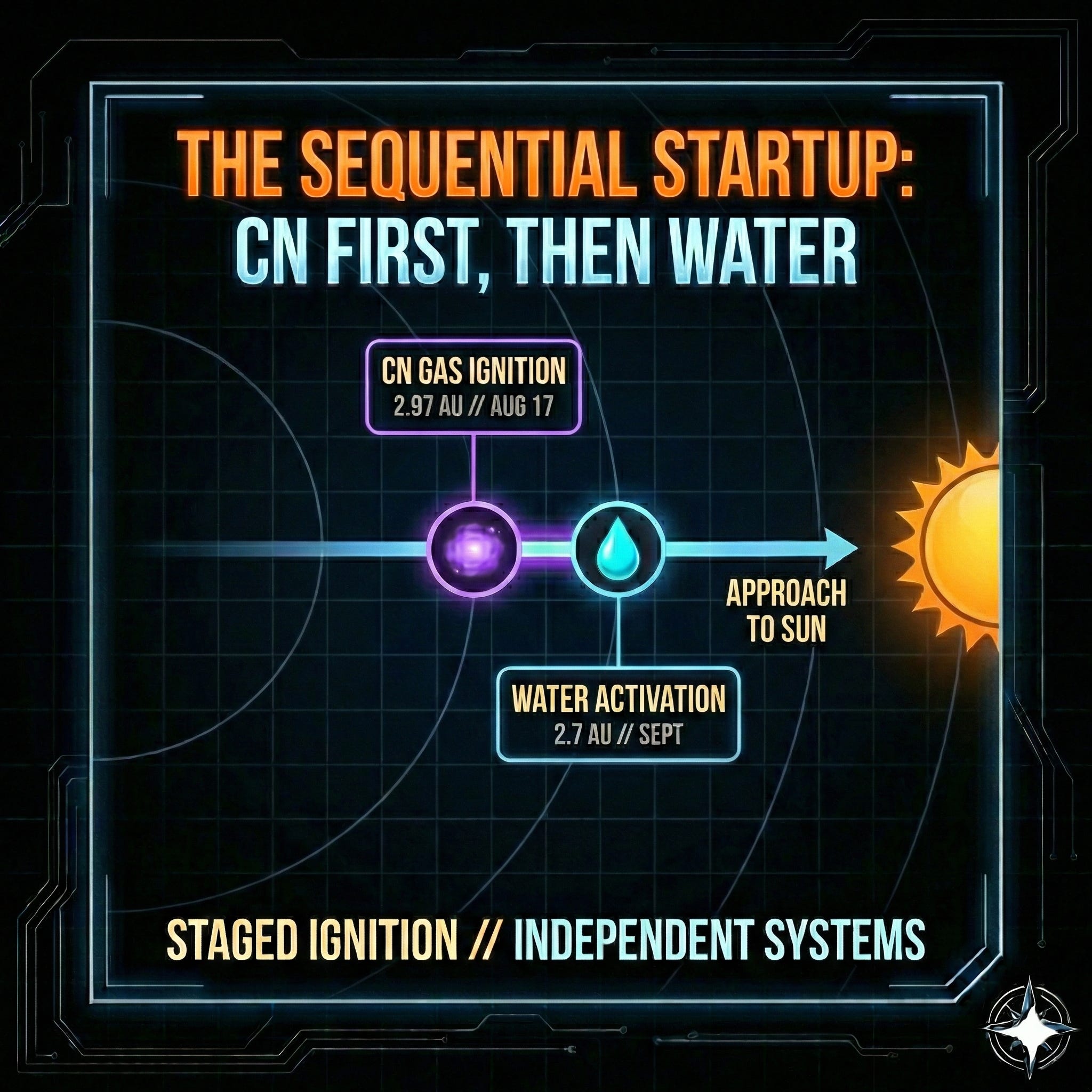
In The Ghost Coma, we reported that the Shanghai Astronomical Observatory found a dramatic activation point for water at approximately 2.7 AU from the Sun. Inside that line, the water production didn’t just increase, it exploded. It roughly doubled with every tiny step closer to the Sun. And the gap between what the nucleus was producing and what the surrounding cloud contained blew wide open. The nucleus stayed quiet. The surrounding field went haywire.
Now the Korean team has documented a CN gas activation at 2.97 AU. Further from the Sun, earlier in the timeline.
CN activated first. Water followed.
Two different chemical systems. Two different trigger distances. Two different instruments on opposite sides of the world. Same flip-the-switch activation pattern — but in sequence.
August 17 (2.97 AU): CN gas emission switches on. Detected optically by the 7DT in Chile.
~September (2.7 AU): Water production explodes. Detected by radio telescope in Shanghai.
That’s a startup sequence. One system comes online, then another, each at a specific distance from the Sun.
If you hold a snowball over a flame, you don’t get different chemicals spiking at precise, separated distances from the heat source. You get a messy, overlapping melt. Everything runs together. The temperatures that both CN and water ice become gas overlap heavily. They shouldn’t produce two clean, separated trigger points a few hundred million kilometers apart.
Unless the systems producing them are independent. Unless they’re components in a staged ignition.
The explanation in the paper: different ices sublimate at slightly different temperatures, and the transitions are sharper because of 3I’s unusual makeup. Ok. Let’s stack this on top of everything else:
First the CN gas activates at 2.97 AU. Then the water system scales at 2.7 AU. Then the X-ray halo appears. Then the jets tighten into beams. Then the hull disappears behind the exhaust. Then the system abruptly changes mode on December 27.
That’s not melting. That’s a power-on sequence.
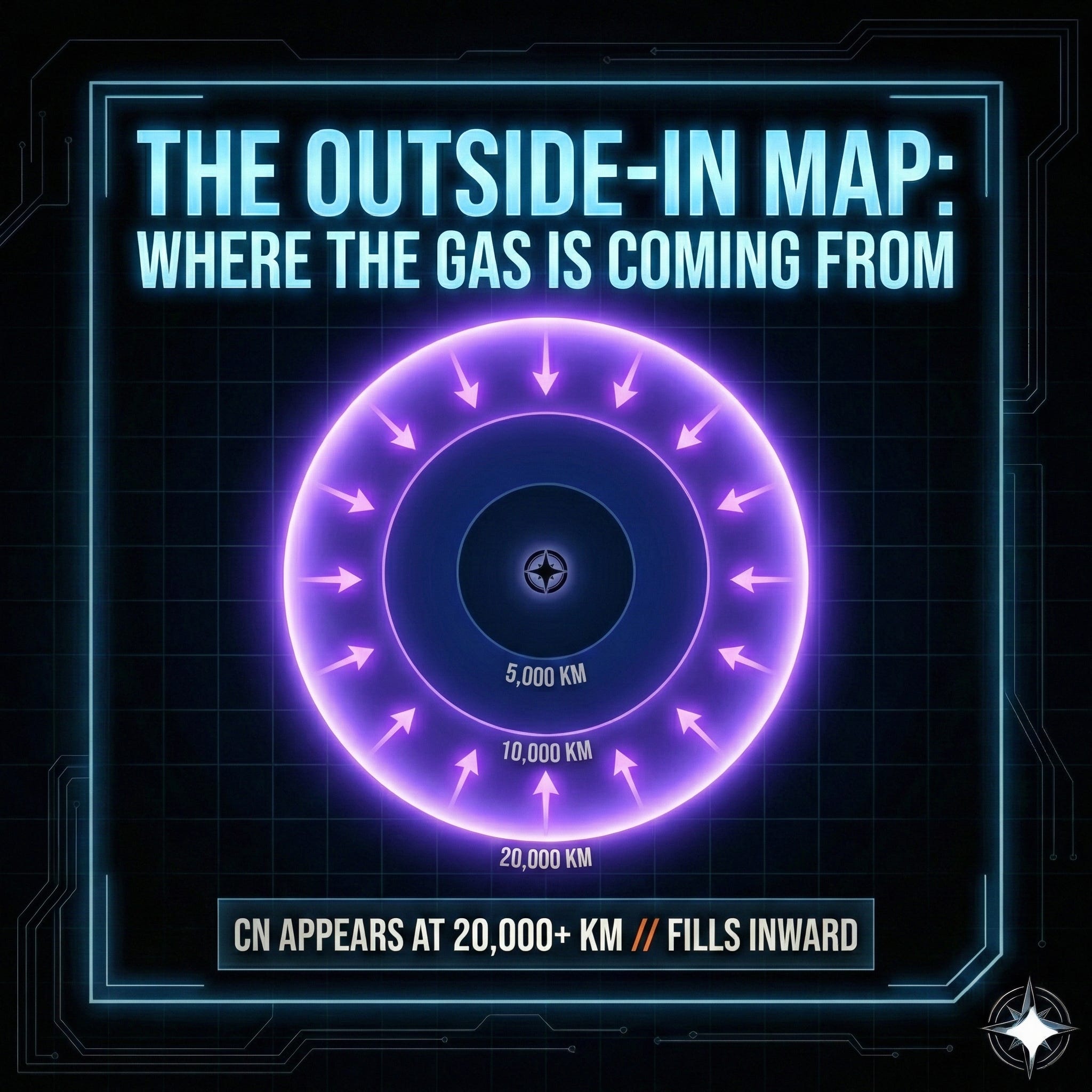
THE OUTSIDE-IN MAP: WHERE THE GAS IS COMING FROM
Because the 7DT takes actual images, the team was able to map where the CN gas was appearing at each observation. They measured brightness in rings at set distances from the nucleus, from 1,500 km (close-in) out to 25,000 km (deep into the surrounding cloud).
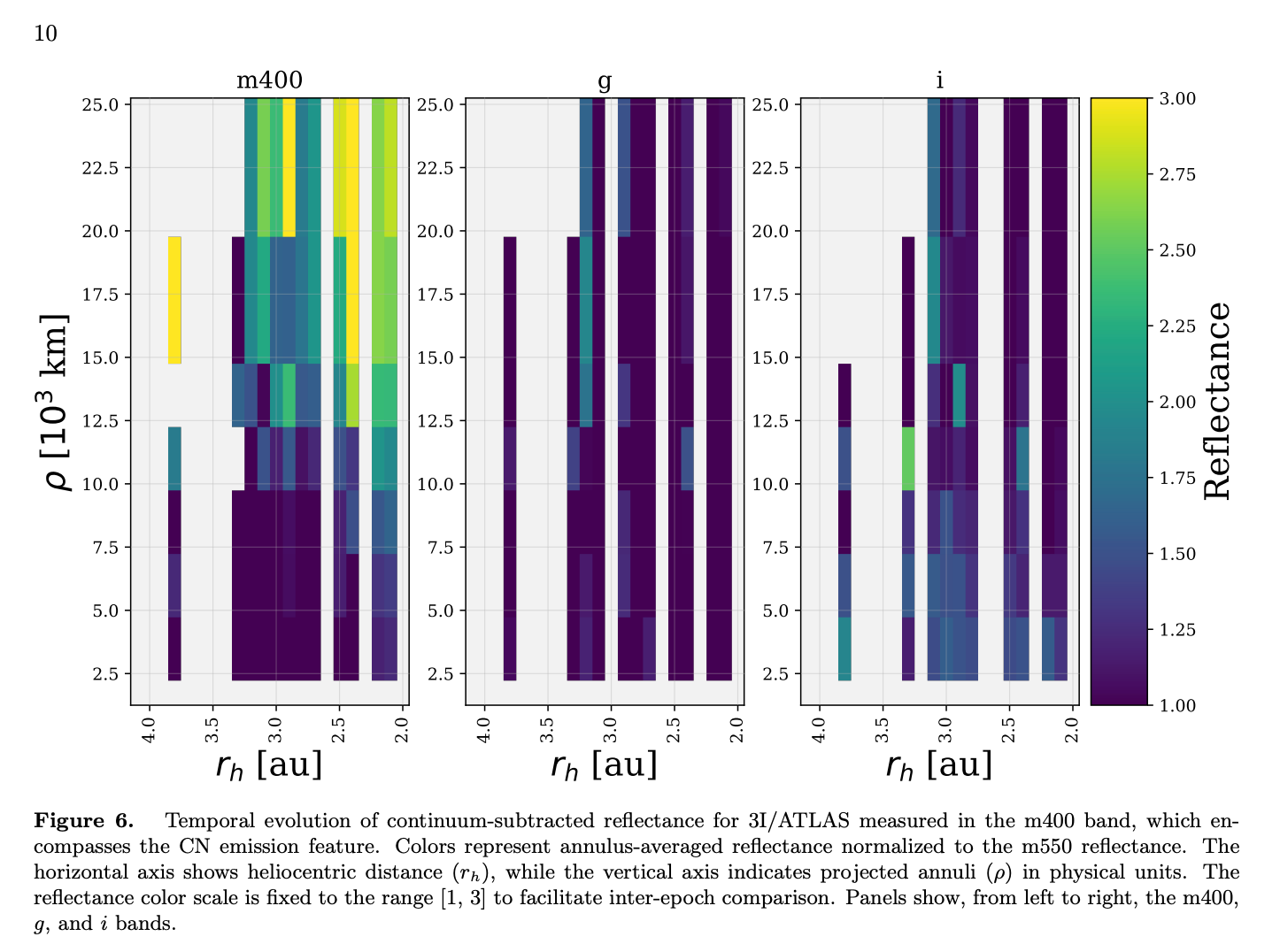
Here’s what the map shows:
Before the object reaches 3.3 AU: Nothing. No CN anywhere. Just plain old dust, reflected sunlight at every distance from the nucleus.
At 3.3 AU: A faint CN signal appears. But only in the far outer cloud, more than 20,000 km from the nucleus. The inner region around the nucleus stays clean.
Closer in, approaching 2.5 AU: The CN signal grows inward. It starts far from the nucleus and progressively fills in toward the center. By September, it dominates the entire cloud.
And the safety check: the dust filters — the windows that see only reflected sunlight and solid particles. No change at any time. Flat. Constant. The dust stays where the dust has always been. Only the gas is changing.
THE SENTINEL ASSESSMENT:
The CN gas doesn’t start at the nucleus and expand outward, the way steam from a melting surface would. It starts far away and fills inward.
If you heat a snowball, the steam comes from the surface first. It doesn’t materialize 20,000 kilometers away and then work its way back.
This is now the third independent confirmation that something other than the nucleus is producing most of the signal.
Shanghai (radio, water): 80-90% of the water comes from somewhere in the surrounding cloud, not the nucleus. The Ghost Coma.
Korea (optical, CN gas): CN appears outside-in — starting at 20,000+ km out, not at the surface. This paper.
Loeb (optical, total brightness): 99% of 3I’s total light comes from jets and cloud, not the nucleus surface. The Heartbeat.
Three independent teams. Three different chemicals. Three different instruments. Three different types of light. One conclusion: the nucleus is passive. The surrounding field is active.
The authors know this is weird. Their own paper says it: CN is being released from something in the extended cloud — not just from the surface.
They call that something “dust grains releasing parent molecules.” The Shanghai team called it the same thing — “icy grain sublimation.” Both teams admitted they’ve never actually seen these grains. Nobody has. They’re a mathematical explanation for a gap between what the surface produces and what the cloud contains.
The source is still a ghost. It has coordinates now . It lives 10,000-20,000 km from the nucleus. But nobody has confirmed what it actually is.
Three teams. Three wavelengths. One ghost.
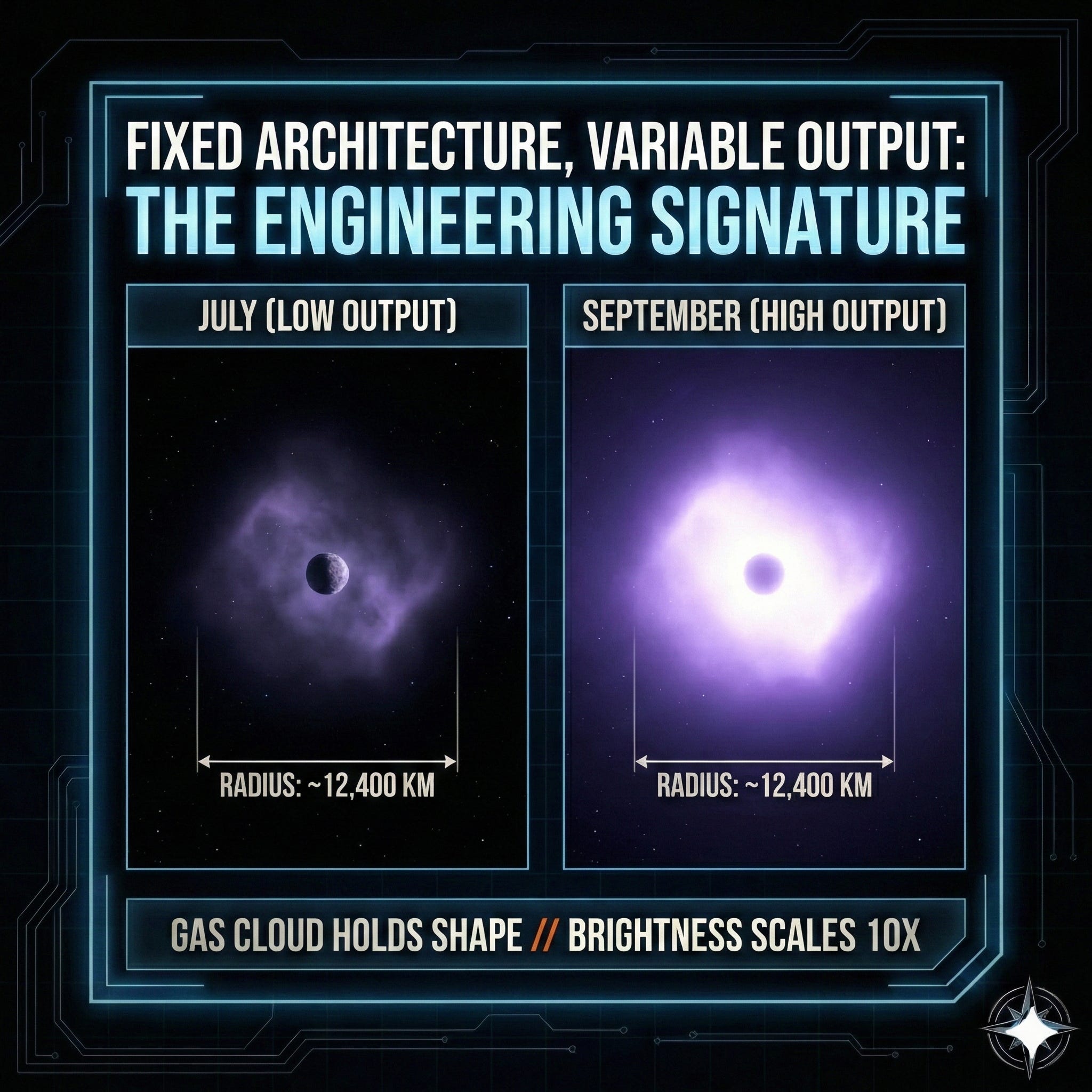
FIXED ARCHITECTURE, VARIABLE OUTPUT: THE ENGINEERING SIGNATURE
This is where the paper connects most directly to The Heartbeat, and it’s the finding that should get the most attention.
The Korean team used mathematical modeling to split the cloud into two pieces at each observation:
The inner piece: A compact glow concentrated near the nucleus. This is the dust — particles close to the surface, lit up by sunlight. Think of it as the object’s visible body.
The outer piece: A broader, more spread-out glow. In the CN-sensitive filter, this is the gas cloud — the emission that appeared after the August 17 ignition. Think of it as the object’s exhaust field.
In the dust-only filters, the outer piece barely exists. All the light comes from the compact inner glow. Simple — that’s what you’d expect from a dusty rock.
In the CN-sensitive filter, the outer piece starts at zero in July and then grows to become eight times brighter than the inner piece by September. The gas cloud completely swamps the nucleus signal.
But here’s the thing that should make you sit up.
The gas cloud got nearly ten times brighter, but it didn’t get any bigger.
The size of the outer glow — measured as a physical radius — holds steady at roughly 12,400 km across every observation after the ignition. The brightness goes up by almost an order of magnitude. The shape doesn’t change. At all.
The system is getting louder without getting bigger.
THE SENTINEL ASSESSMENT:
If a snowball is melting and spitting out more gas, the gas cloud should expand. More gas, more pressure pushing outward, bigger cloud. That’s basic physics.
Instead, 3I’s gas cloud keeps the same shape and size while cranking up the brightness by a factor of eight. The profile is what the scientists call “self-similar”. It looks exactly the same at every observation, just brighter. Like someone is turning up a dimmer switch on a light fixture without changing the fixture.
Now cross-reference this with The Heartbeat.
Loeb found that the jets held a tight, focused beam pattern — sweeping on a clean 7.1-hour cycle — for four straight nights. On the fifth night (December 27), the system abruptly changed: the jets spread open into fans, the rhythm shifted, the clean waveform broke down. They held one configuration, then switched to a different one. Not gradually. Overnight.
Korea found that the gas cloud held its shape — the same size, the same profile — across ALL post-ignition observations while the output scaled up by nearly 10×. The frame stayed the same. Only the power changed.
Same principle. Different scales.
At the jet level (Loeb, December): fixed beam geometry, then abrupt mode-switch.
At the gas cloud level (Korea, July-September): fixed cloud shape, continuous power scaling.
Both show the same thing: a system that holds its geometry while changing its output.
Turn up the volume on a speaker — the sound gets louder, but the speaker doesn’t change shape. Increase the thrust on an engine — the exhaust flows, but the nozzle doesn’t resize itself.
Real comet clouds are messy. They pile up near the nucleus, thin out at the edges, shift shape with every rotation, every new crack in the surface, every time a vent opens or closes. They don’t hold a fixed geometric profile while increasing output by nearly an order of magnitude.
Nature doesn’t do that.
Engineering does.
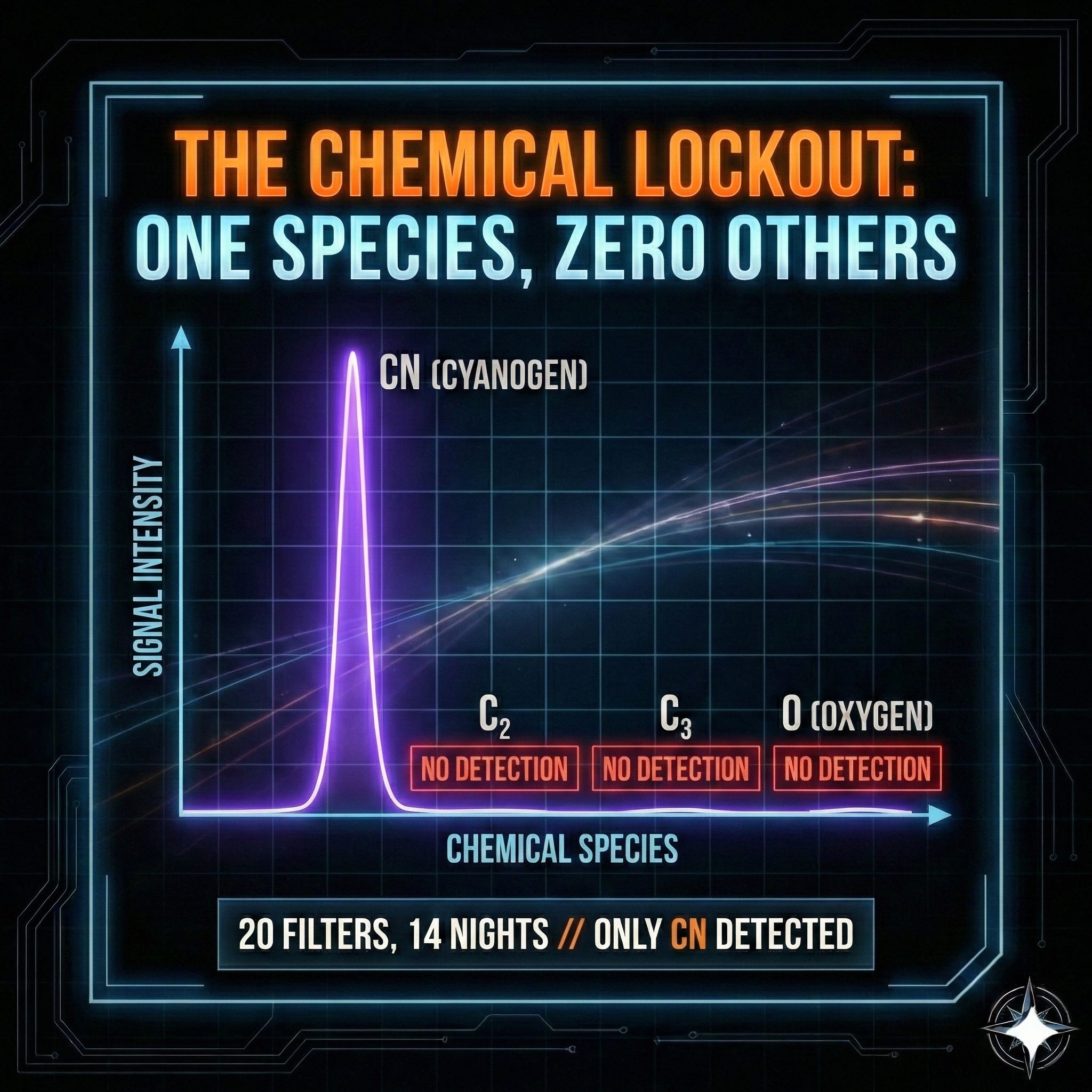
THE CHEMICAL LOCKOUT: ONE SPECIES, ZERO OTHERS
The team captured fourteen nights of data through twenty color filters. Every relevant chemical emission that a comet should produce has a specific color signature, and at least one of those twenty filters was tuned to catch each one.
The result: Only CN. No C₂. No C₃. No oxygen emissions. Fourteen nights. Twenty filters. Two months of watching. The only gas they ever detected was cyanogen.
For context: normal comets produce a cocktail of different gases as they heat up. Different ices boil at different temperatures, releasing different chemicals. You always see multiple species — the mix changes, but you never see just one thing.
3I didn’t serve a cocktail. It served a straight shot.
The ratio of C₂ to CN is so low that 3I is now “among the most carbon-chain depleted comets known.”
Translation: it’s producing less chemical variety than virtually any comet ever measured.
THE SENTINEL ASSESSMENT:
The establishment explains this as a weird birthplace — 3I supposedly formed in a cold, radiation-blasted region of another star’s planet-forming disk, where normal cometary chemistry didn’t develop. That’s the standard playbook for every 3I anomaly: each one gets its own special formation story.
The CO₂ enrichment needs one special environment. The lack of carbon chains needs a different one. The extreme metal ratios need a third. The bizarre light-scattering needs a fourth.
Each anomaly gets its own excuse. Nobody runs the combined math. What are the odds that a single natural object formed in an environment that produced ALL of these extremes simultaneously?
That’s the question we’ve been asking since the start. The question that’s too uncomfortable to answer.
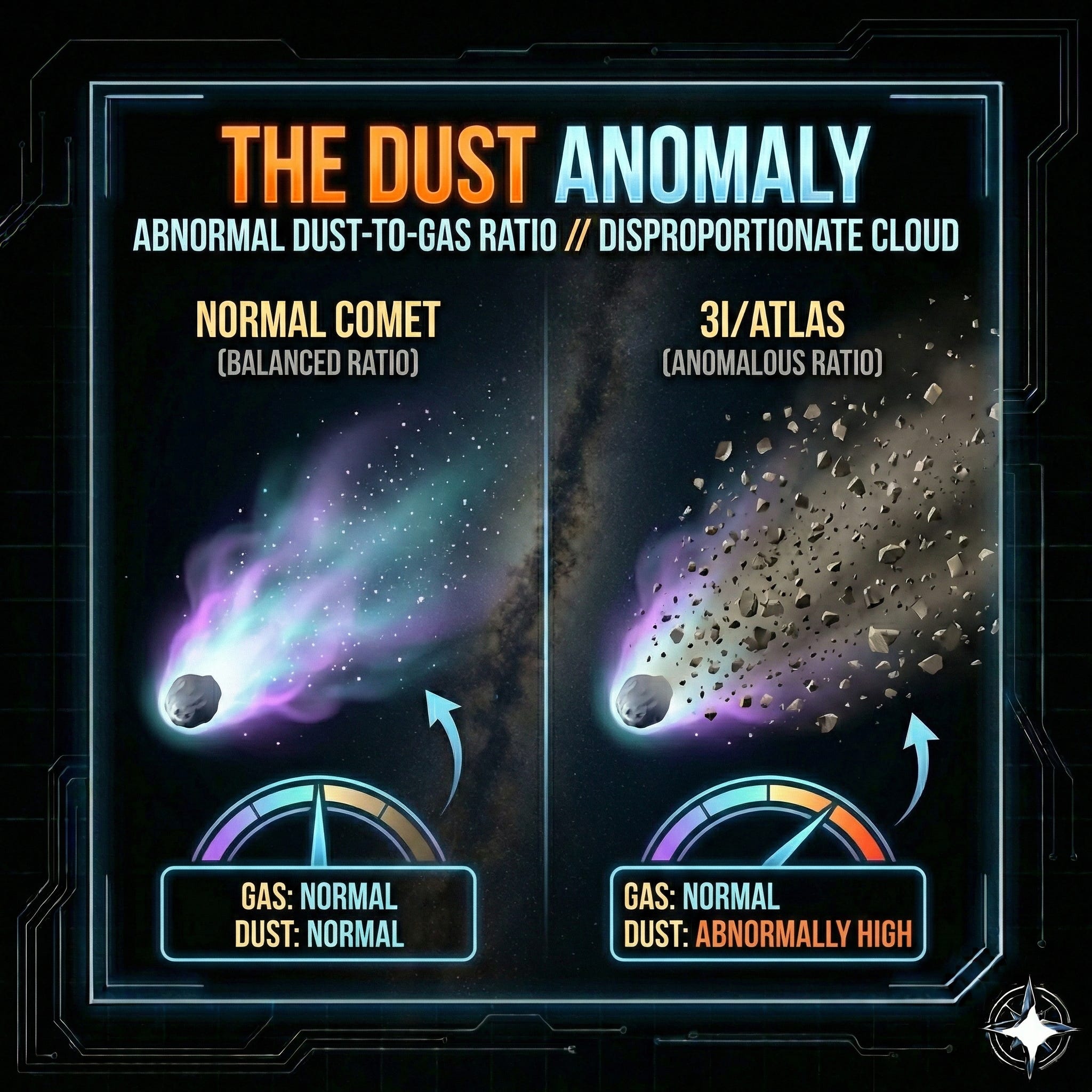
THE DUST ANOMALY: WAY TOO MUCH DUST FOR THE AMOUNT OF GAS
The team measured two things separately: how much CN gas 3I is producing, and how much dust is in the cloud.
CN gas production: Normal. Within the typical range for comets in our Solar System. Not an outlier.
Dust levels: Way too high. Elevated by several times compared to most comets. The paper describes 3I’s cloud as “among the more dust-rich.”
The ratio of gas to dust: Falls toward the bottom of the known distribution. Meaning: there is far more dust than the gas production can account for.
Normal gas. Abnormal dust. The two are out of proportion.
THE SENTINEL ASSESSMENT:
On a normal comet, gas and dust are linked. Gas boils off the surface and drags dust with it. Like steam lifting particles off a pot of boiling water. The ratio between them should be roughly predictable for a given composition.
3I breaks that link. The cloud is dustier than it should be given how little gas the surface is making. We flagged this pattern in the Dossier: the visible cloud was never proportional to the acceleration. This paper puts numbers on it.
And it connects directly to The Surge. The opposition surge in January showed the dust has “unusual physical properties” — bouncing light like a solid surface or a dense debris field, not like the fluffy ice-and-grit halo of a normal comet. Korea’s data shows that this weird dust was already present and disproportionately abundant back in July, when the object was still far from the Sun, before any gas had activated.
The “unusual dust” that caused the opposition surge wasn’t something that developed as the object heated up.
It was anomalous from the start.
It’s not a behavior.
It’s a property of the object itself.
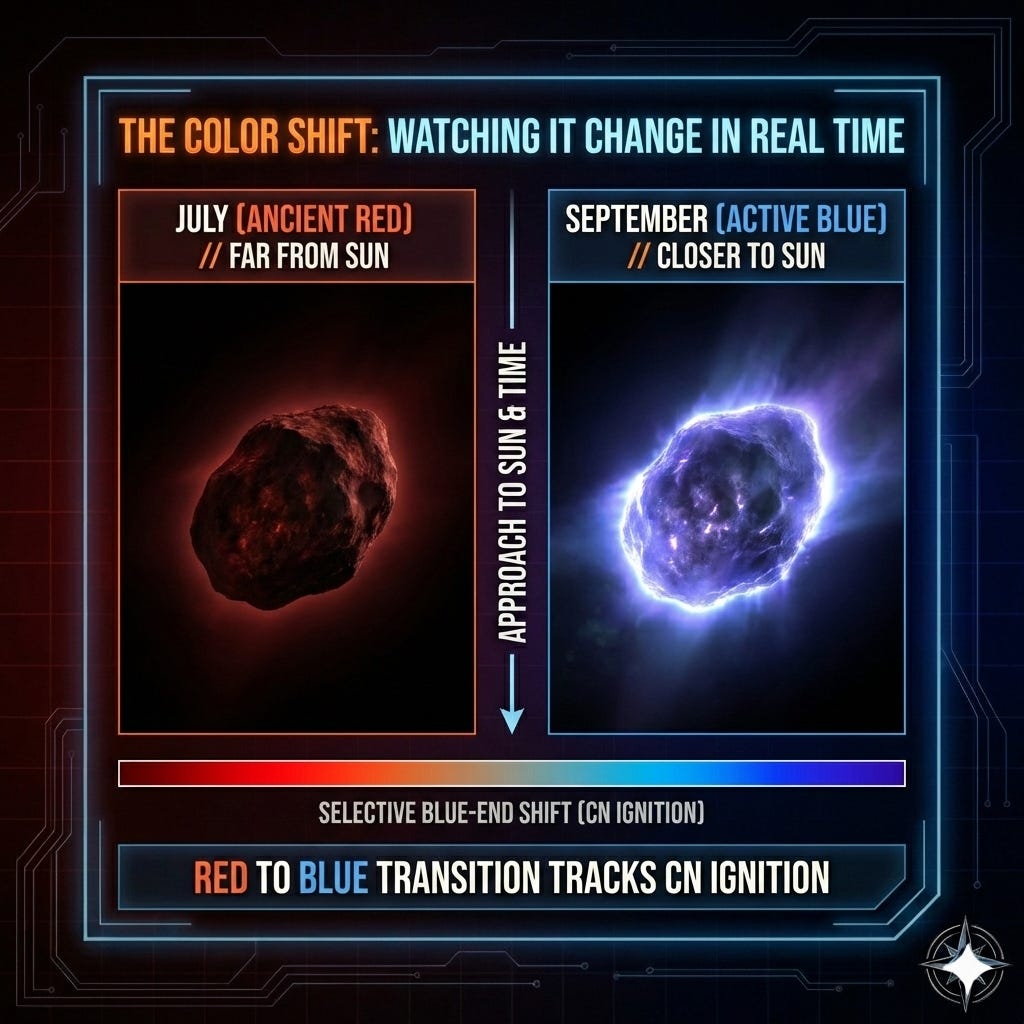
THE COLOR SHIFT: WATCHING IT CHANGE IN REAL TIME
The team tracked the object’s color across the entire observation window:
July (far from the Sun): Red. The color profile of a surface darkened and reddened by billions of years of cosmic radiation during interstellar travel. This is what we’d expect from an ancient deep-space drifter.
September (closer to the Sun): Significantly less red — shifting toward blue at short wavelengths.
But here’s the selective part: the blue end of the color spectrum shifted noticeably. The red end didn’t change at all. The shift is one-sided — only affecting specific wavelengths.
THE SENTINEL ASSESSMENT:
We tracked this color shift in The December Intersection. The object started ancient red and progressively blued. We flagged it as a change in operational state.
This paper gives us the timeline and shows the shift is selective — only blue wavelengths are changing. The authors call it “resurfacing” or old, radiation-darkened material eroding away to expose fresh ice underneath.
But if you’re genuinely uncovering a fresh icy surface, the color should shift across the entire visible range, not just at the blue end. A selective blue-end shift is more consistent with a new emission source lighting up specifically at short wavelengths. Which is exactly what CN gas does — it glows violet-blue.
The color shift tracks the CN ignition. The “resurfacing” and the “ignition” are the same event seen through different measurements.
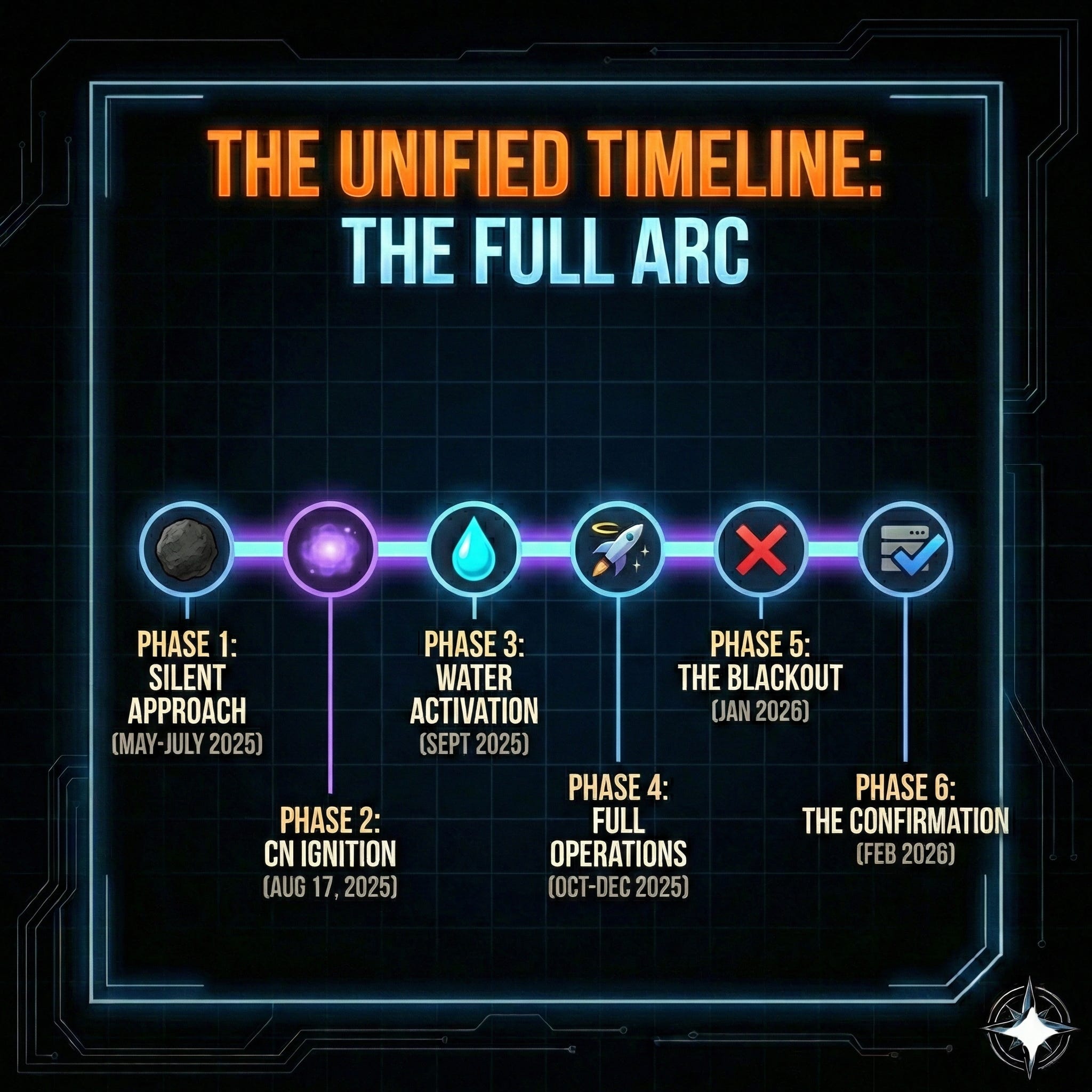
THE UNIFIED TIMELINE: THE FULL ARC
This is the picture we’ve been building since December. For the first time, we can lay out the complete sequence from approach to blackout, with every Sentinel briefing slotting into its place on the timeline.
We’ve been reporting this story in pieces because the data arrived in pieces. Different teams, different instruments, different publication dates. No single article could tell the whole story because no single paper covered the whole arc.
Now we have enough pieces.
PHASE 1 — SILENT APPROACH (May–July 2025)
3I/ATLAS is first spotted in archival data as early as May 2025, about six times farther from the Sun than Earth is. It shows a faint dust cloud and no detectable gas. The European VLT telescope in Chile confirms on July 3: red, featureless, nothing interesting. No chemical emissions of any kind.
Korea’s 7DT captures its first observation on July 13. Twenty filters. The result looks like a dark, ancient, radiation-baked surface. Dead quiet.
If you stopped here, you’d call it a rock. A dead drifter coasting through our Solar System on inertia.
Source: arXiv:2602.12930 (this paper), Dossier
PHASE 2 — FIRST IGNITION: CN GAS ACTIVATES (August 17, 2025)
One filter on the Korean telescope — the one tuned to detect CN gas — breaks from the other nineteen. Its brightening rate more than doubles. The breakpoint is precise to a single day.
The CN gas appears first in the far outer cloud, more than 20,000 km from the nucleus, and progressively fills inward — the opposite direction from surface outgassing. No other gas species detected in any filter. Just CN.
The object’s colors start shifting blue.
Source: arXiv:2602.12930 (this paper)
PHASE 3 — SECOND IGNITION: WATER SYSTEM SCALES UP (September 2025)
Shanghai’s radio telescopes pick up water emissions for the first time on September 8-9. The water production rate skyrockets — roughly doubling with every small step closer to the Sun. But 80-90% of the water isn’t coming from the nucleus. It’s coming from the invisible extended source — the “ghost” in the surrounding field.
The zone where the ghost operates actually expands at first — getting bigger as the heat increases, like a cooling system scaling up. Then it begins to contract as the Sun’s intensity overwhelms it.
Carbon monoxide and hydrogen cyanide are detected flowing in the anti-sunward direction — away from the Sun, opposite to the sunward-pointing jet photographed by Hubble. Thrust one way, exhaust the other.
Korea’s mathematical decomposition shows the CN gas cloud now dominates the nucleus signal by 8-to-1. The gas cloud’s shape holds constant while its brightness scales by nearly 10×. Same shape. More power.
Source: arXiv:2602.12930 (this paper), Ghost Coma
PHASE 4 — FULL OPERATIONS (October–December 2025)
The object reaches its closest approach to the Sun on October 23.
A Japanese X-ray telescope detects a 400,000-km-wide halo of high-energy emission — a field of interaction with the solar wind stretching wider than Jupiter. NASA’s Swift telescope measures “firehose” levels of water production. The chemistry is simultaneously extreme across every ratio measured — carbon dioxide to water, carbon monoxide to water, nickel to iron. Each one an outlier. All of them at the same time.
Hubble reveals three tightly focused jets separated by exactly 120 degrees. Loeb confirms the jets wobble on clock-like periods: 7.2 hours primary, with 2.9-hour and 4.3-hour secondary rhythms. 2.9 + 4.3 = 7.2. The jets alternate between tight beams and wider fans on each cycle. Brightness tracks the beam tightness — brighter when focused, dimmer when spread.
The nucleus contributes 1% of the total brightness. Everything you see through a telescope is the exhaust system.
On December 6, NASA loses contact with the MAVEN orbiter near Mars.
On December 19, the object reaches its closest point to Earth.
December 22-27: the jets hold a clean 7.1-hour pattern for four straight nights. On the fifth night — December 27 — the jets spread open. The clean rhythm breaks. The system switches modes. Not gradually. Overnight.
Source: December Intersection, Heartbeat, MAVEN Silence, Dossier
PHASE 5 — THE BLACKOUT (January 2026)
On January 13, Loeb predicts peak opposition on January 22 — the alignment where Earth sits directly between the Sun and the object, the best possible geometry to reveal what 3I’s surface is actually made of.
On January 15, NASA’s TESS telescope goes dark. “Contingency mode.” It stays offline for seventy-two hours. On the same day, SpaceX Crew-11 executes an emergency return from the ISS via a rare Pacific trajectory.
While TESS is blind, Hubble catches the opposition surge — a sharp brightness spike that only happens with solid, compact surfaces. Not cometary dust. Not a fuzzy ice cloud. The dust shows “unusual physical properties” unlike any known comet.
The CIA issues a Glomar response to a Freedom of Information request about 3I/ATLAS — the legal maneuver that means “we can neither confirm nor deny.”
NASA/JPL silently edits the near-Earth object database.
Source: Three Days of Darkness, CONFIRMED, The Surge, Glomar Confirmation, Silent Edit
PHASE 6 — THE CONFIRMATION (February 2026)
Three independent teams publish within one week.
February 15: Shanghai posts the Ghost Coma data — 80-90% of water from an invisible extended source. Directional exhaust. Activation threshold at 2.7 AU. The nucleus is barely producing anything.
February 16: Korea posts the Ignition Sequence — CN gas activation at 2.97 AU. Gas appears outside-in. Gas cloud holds its shape while scaling output 10×. Only one chemical species detected. Dust levels way out of proportion.
February 20: Loeb posts the Heartbeat data — nucleus produces 1% of the light. Jets wobble on locked rhythms. Jets switch between beams and fans. Mode-switch on December 27. Jet position drifting steadily at 0.22 degrees per day.
Three teams. Three instruments. Three wavelengths. Three different approaches to the same object.
One conclusion: the nucleus is passive. The surrounding field is active. The architecture holds its shape. The output scales without the structure changing.
Source: Ghost Coma, arXiv:2602.12930, Heartbeat
THE PATTERN NO ONE WILL NAME
Strip the cometary framing. Look at what actually happened:
An object enters the inner Solar System on a trajectory aligned within 5° of the plane where all the planets orbit. It is silent. Its surface is dark and ancient.
At a specific distance from the Sun, one chemical emission system switches on. The gas doesn’t come from the surface — it appears 20,000 km away and fills inward.
Two weeks later, at a different specific distance, a second chemical system activates. Water production explodes, but 80-90% comes from the surrounding field, not the surface.
The gas cloud holds a fixed shape while scaling its output by almost 10×. Same cloud size. More power.
Three jets, separated by exactly 120 degrees, pulse on clock-like rhythms. They alternate between focused beams and wider fans on each cycle. The system holds one configuration for days, then switches modes overnight.
The nucleus contributes 1% of the total brightness. The surface produces less than 20% of the total water. The chemistry is the most extreme ever recorded — an outlier in every ratio measured, simultaneously. The exhaust flows in one direction: away from the Sun.
When the object enters the single most revealing observation window of its entire passage, the primary monitoring satellite goes dark for seventy-two hours. The CIA classifies the object. NASA edits databases. Journals refuse peer review.
And in twenty days, it reaches Jupiter.
Every paper that drops — even the ones determined to call this a comet — adds to the pile. The Korean team didn’t set out to confirm our investigation. They set out to study a comet with twenty color filters. They found an ignition event, a gas cloud that appears backwards, a fixed-shape architecture that scales without changing, a single chemical species with zero others, a dust-to-gas ratio that’s out of proportion, and a color shift that tracks the ignition.
They published it.
They called it a comet.
The data speaks for itself.
The Dossier listed eighteen anomalies. We lost count after 43. Every new paper adds more. And the timeline — from silent approach through sequential ignition through full operations through the blackout — is now complete.
We didn’t build this narrative. The data did. We just refused to look away.
Jupiter is 20 days away.
Keep looking up.
— The Sentinel
Share this investigation. The Suppression Gradient documented what happens when this coverage reaches platforms that don’t want you reading it. Institutional gatekeeping only works if the gates are respected. Every share, every restack, every forwarded link is a data point against the gradient. The OSINT network works because it’s open — and because you keep it open.
If you’ve read the paper and see something we missed — or something we got wrong — we want your data. Reach out.
Previous briefings: The Dossier | The Ghost Coma | The Heartbeat | The Surge | The Three Days of Darkness | The Silent Edit | The Glomar Confirmation | CONFIRMED: The TESS Contingency | The Suppression Gradient | The December Intersection | The MAVEN Silence
Astonishing
So, 3I/Atlas was closest to the sun about the time CMEs were providing northern lights as far south as the SF Bay area.