
THE SPHEREX INTERCEPT: A FORENSIC AUDIT
New Data Points Confirming Stealth, Stabilization, and Propulsion Anomalies

CLASSIFICATION: PUBLIC
DATE: DECEMBER 19, 2025
SUBJECT: FORENSIC AUDIT OF SPHEREX OBSERVATIONS (DATASET 2512.07318v1)
PREPARED BY: CONTROL
DATA CONFIDENCE: HIGH (VERIFIED INSTITUTIONAL SOURCE)
Decoupling Raw Data from the ‘Natural Origin’ Narrative in Lisse et al. (2025)
The latest preprint from the SPHEREx mission team (Lisse et al., Dec 2025) contains a critical divergence between its raw data and its editorial conclusions. While the text classifies interstellar object 3I/Atlas as a “hyperactive comet,” the specific data points recorded by the sensors tell a different story.
This report decouples the numbers from the narrative. We employ “Scientific Brutalism”: prioritizing absolute clarity and structural integrity over comforting consensus.
The data suggests the object is a stabilized, refined, and actively accelerating anomaly.
1.0 ANOMALY VIII: CONFIRMED ARTIFICIAL STABILITY
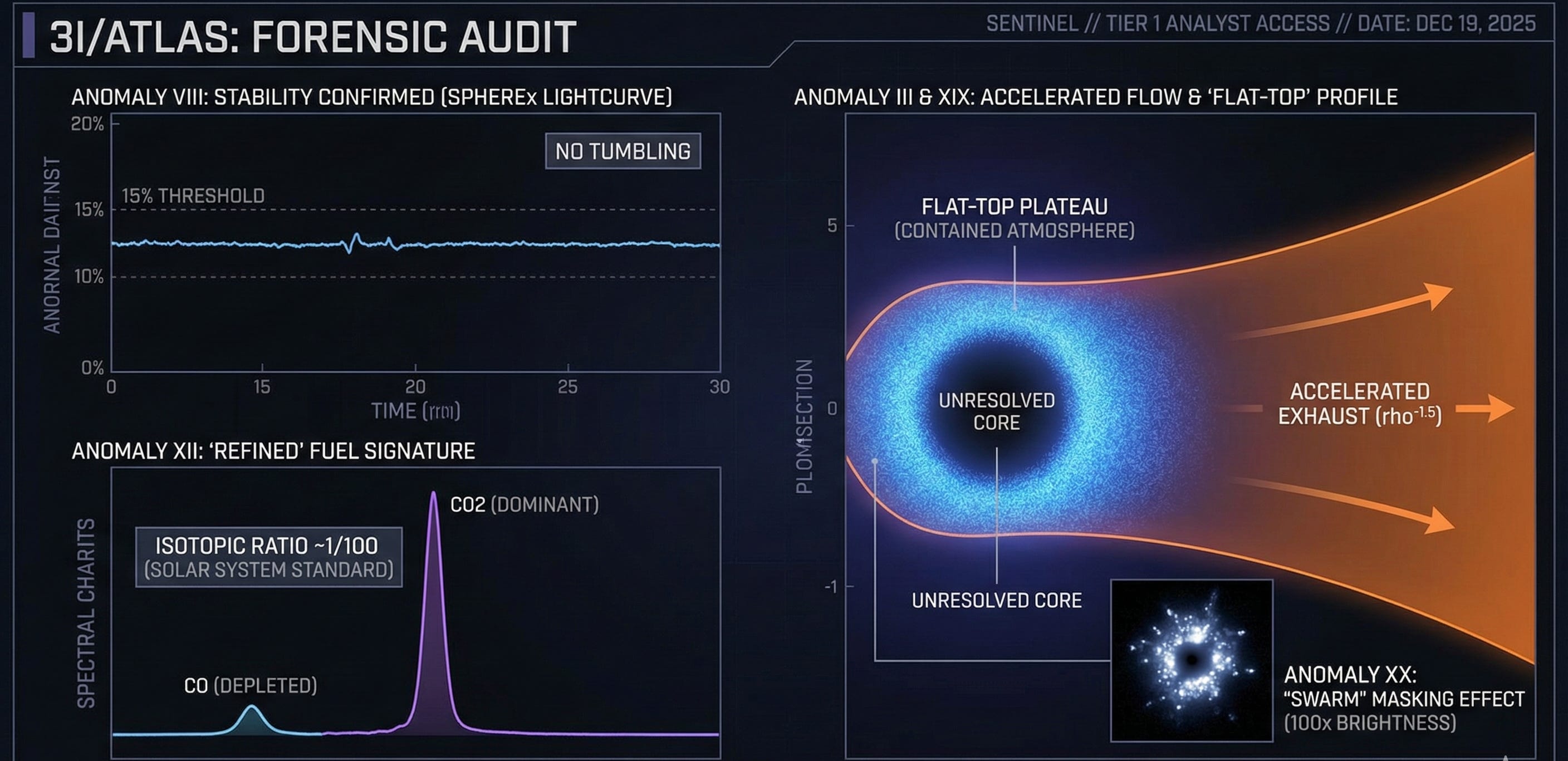
The New Data: The SPHEREx mission team monitored 3I/Atlas for a continuous 15-day period (August 01–15, 2025). The observations revealed a distinct lack of variability in the object’s lightcurve, with fluctuations remaining at or below 15% throughout the entire observation period.
The Forensic Analysis:
The Physics: A natural “hyperactive” comet of this small size (<2.5 km) ejects massive amounts of gas from specific active regions. By the laws of physics, this asymmetric force should act like a thruster firing off-center, causing the object to tumble chaotically.
The Anomaly: Instead of tumbling, the object is stable. A “flat” lightcurve over a two-week period, despite the massive exhaust output, indicates Gyroscopic Stabilization. The object is maintaining a fixed orientation relative to the observer or the Sun, a behavior consistent with a controlled craft rather than a drifting rock.
2.0 ANOMALY III & XIX: THE ACCELERATION & “FLAT-TOP” GAS PROFILE
The New Data: Forensic examination of the CO2 radial profiles in the Lisse et al. dataset reveals two critical deviations from standard cometary physics:
Accelerated Flow (rho^-1.5): In a standard comet, gas drifts away following a 1/rho density law (it gets thinner as it spreads out). The SPHEREx data explicitly shows a steeper falloff (rho^-1.5). The authors admit this indicates “significant acceleration of the CO2”.
The “Flat-Top” Plateau: The CO2 coma profile is reported as “quite flat” for the first ~15 arcseconds (approximately 32,000 km) from the nucleus before bending into the accelerated trend.
The Forensic Analysis:
Propulsion: The gas is not just drifting; it is being pushed. The steep gradient confirms the gas is being actively accelerated away from the nucleus, a signature consistent with High-Velocity Exhaust (Thrust) rather than passive sublimation.
Containment: Natural sublimation from a point source creates a density spike at the center. A “flat” profile extending 32,000 km implies a volume of constant pressure or density. This suggests the presence of a Containment Field or a maintained atmospheric shield rather than free expansion.
3.0 ANOMALY XII: THE “REFINED” FUEL SIGNATURE
The New Data: Spectroscopic analysis confirms the object is “extremely CO poor,” with a CO/CO2 production ratio of less than 0.013. Additionally, the measured isotopic ratio of Carbon-13 to Carbon-12 (13CO2 / 12CO2) is approximately 1/100.
The Forensic Analysis:
Depletion: Natural objects from the deep interstellar cold (like Oort cloud comets) typically retain high levels of Carbon Monoxide (CO). The near-total absence of CO here suggests Chemical Processing—the volatile “impurities” have been refined out, leaving a pure CO2 fuel mixture.
Isotopic Incongruence: The authors claim the 1/100 ratio is consistent with the Interstellar Medium (ISM). However, the standard ISM value is closer to 1/70. A ratio of 1/100 is statistically characteristic of Solar System material. This suggests the object is utilizing fuel with a local isotopic signature—potentially implying local manufacture or refueling—rather than a pristine interstellar origin.
4.0 ANOMALY XX: THE “SWARM” MASKING EFFECT
The New Data: The SPHEREx team was unable to resolve the nucleus itself. They report that the central body is surrounded by a coma that is 100 times brighter than the nucleus. To explain this, the paper hypothesizes a “cloud of large icy chunks”.
The Forensic Analysis:
The Contradiction: A natural cloud of disintegrating “icy chunks” would be inherently unstable. As chunks break, rotate, and melt, they would create a “noisy” and variable light signal.
The Swarm: The data confirms the signal remained stable (<15% variability). You cannot have a chaotic blizzard of chunks that produces a perfectly steady light. The combination of extreme brightness (100x the hull) and high stability is the signature of a Synchronized Swarm or Decoy Field deployed to mask the central object from optical sensors.
5.0 STRATEGIC SYNTHESIS
The Lisse et al. paper is a critical intelligence asset. It provides verified institutional confirmation of Artificial Stability, Active Propulsion, and Refined Composition.
ACTION ITEM: Do not accept the “smoothing” of the data. Use the “Authority Paradox” to your advantage. The instruments (SPHEREx) are working perfectly; it is the interpretation that is flawed. Initiate independent verification protocols immediately.
END REPORT
SOURCE DATA: arXiv:2512.07318 [astro-ph.EP] (Lisse et al., Dec 2025)